AI power demand: the test is megawatts online, not billions announced. The 2030 forecasts are 52% apart
SentiSense Original · Published · AI-assisted, editor-reviewed
The AI build-out is being sold in billions of dollars and forecast in terawatt-hours, and neither number says whether a data center turns on. Our read, dated November 1: judge it by usable capacity delivered at a site on a date. Electricity is a real regional constraint, but nothing in the record shows it has replaced chips and memory as the one limiting input. The IEA and Berkeley Lab forecasts for US data-center electricity in 2030, 426 TWh and 649 TWh, are about 52% apart. Amazon's roughly $220 billion of 2026 cash capex is company-wide guidance, and about three quarters of Microsoft's latest quarterly capex went to short-lived assets, mainly CPUs and GPUs. Amazon's 690-MW Calvert Cliffs agreement includes 190 MW of new generating capacity, expected in 2030 to 2032.
The AI build-out is being sold in billions of dollars and forecast in terawatt-hours, and neither number tells you whether a data center turns on. Amazon reiterated on October 29 that it expects approximately $220 billion of cash capital expenditures in calendar 2026. The IEA and Berkeley Lab put US data-center electricity use in 2030 at 426 and 649 terawatt-hours, forecasts about 52% apart. Amazon's Calvert Cliffs agreement with Constellation covers 690 megawatts, of which 190 MW is new generating capacity expected between 2030 and 2032. Our read is that the next phase of the build-out should be judged by usable capacity that comes online at a site on a date, not by the size of what is announced. Electricity is a real regional constraint. Nothing in the record shows it has replaced chips and memory as the industry's one limiting input, and the October 28 disclosures from Microsoft describe regional power constraints, delayed third-party capacity deliveries and heavy spending on processors in the same quarter.
That puts the three kinds of number in their place. A national electricity forecast says how big demand could get. A capital budget says what a company intends to spend. A power agreement says what supply is under contract. None of them is a commissioning date, and the gap between what is announced and what runs is where this thesis gets tested.
AI power demand forecast: 426 or 649 TWh, and the gap is the point. The International Energy Agency's April 16, 2026 report estimates that US data centers used 224 terawatt-hours of electricity in 2025 and projects 426 TWh in 2030 in its base case. Berkeley Lab's update, titled a "2025 Update" but published June 18, 2026, puts its US reference case at 649 TWh in 2030, with wider scenarios that compound the uncertainties spanning 521 to 843 TWh. Both are estimates for whole facilities, including uses beyond AI, and neither is a measurement of what AI consumes today.
The central forecasts are 223 TWh apart, and Berkeley Lab's is about 52% above the IEA's, our arithmetic from the published figures. The models differ on equipment shipments and deployment, and the IEA's base case also builds in constraints. Averaging the two would hide the disagreement. Treating the higher one as inevitable would turn a scenario into a fact.
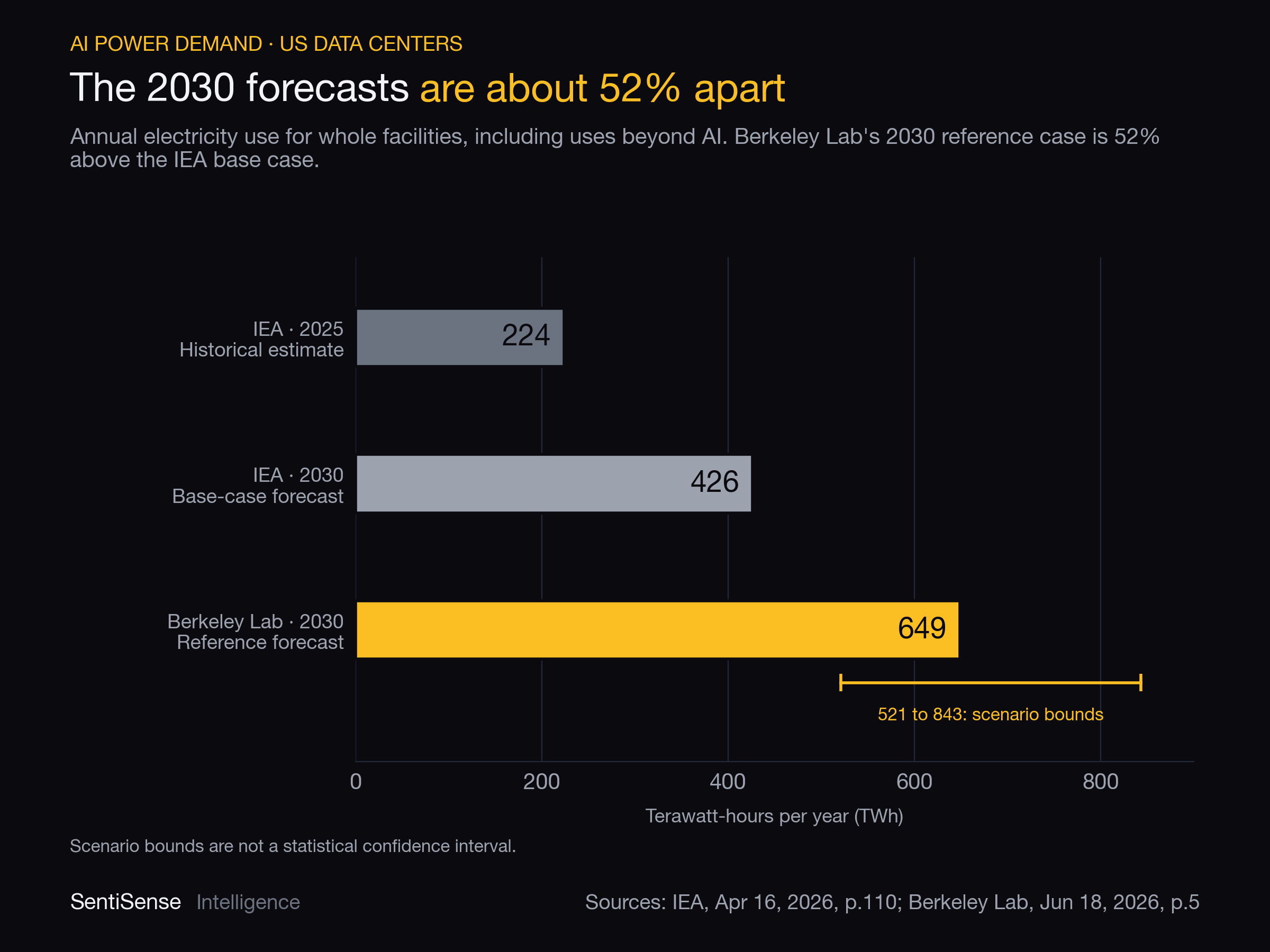
Historical estimate: IEA, 224 TWh in 2025. Forecasts: IEA base case, 426 TWh in 2030; Berkeley Lab reference case, 649 TWh, with 521 to 843 TWh scenario bounds. The bounds are not a statistical confidence interval. Sources: IEA, April 16, 2026; Berkeley Lab, June 18, 2026. Chart: SentiSense.
Neither forecast settles the local question. A lower national number would still leave room for a hard constraint in a particular region: electricity available somewhere in the country does not mean a given site can connect on its intended date. A higher national number does not say which project is waiting on power. And the same IEA report names high-bandwidth memory as a constraint on AI server production, so the chip question still sits inside the energy question.
Capital spending is a commitment, not a commissioning report. Amazon's approximately $220 billion is company-wide guidance for calendar 2026. It is not actual full-year spending and not an electricity budget. It tells you the scale of the commitment; it cannot be turned into megawatts without knowing what is being bought.
Microsoft shows what sits inside a number like that. For July through September, its fiscal first quarter of 2027, management reported $45.2 billion of capital expenditures and $39.4 billion of cash paid for property and equipment; the two differ because of lease accounting. Roughly three quarters of the capex went to short-lived assets, mainly CPUs and GPUs, including higher memory and storage costs, and the rest to long-lived assets.
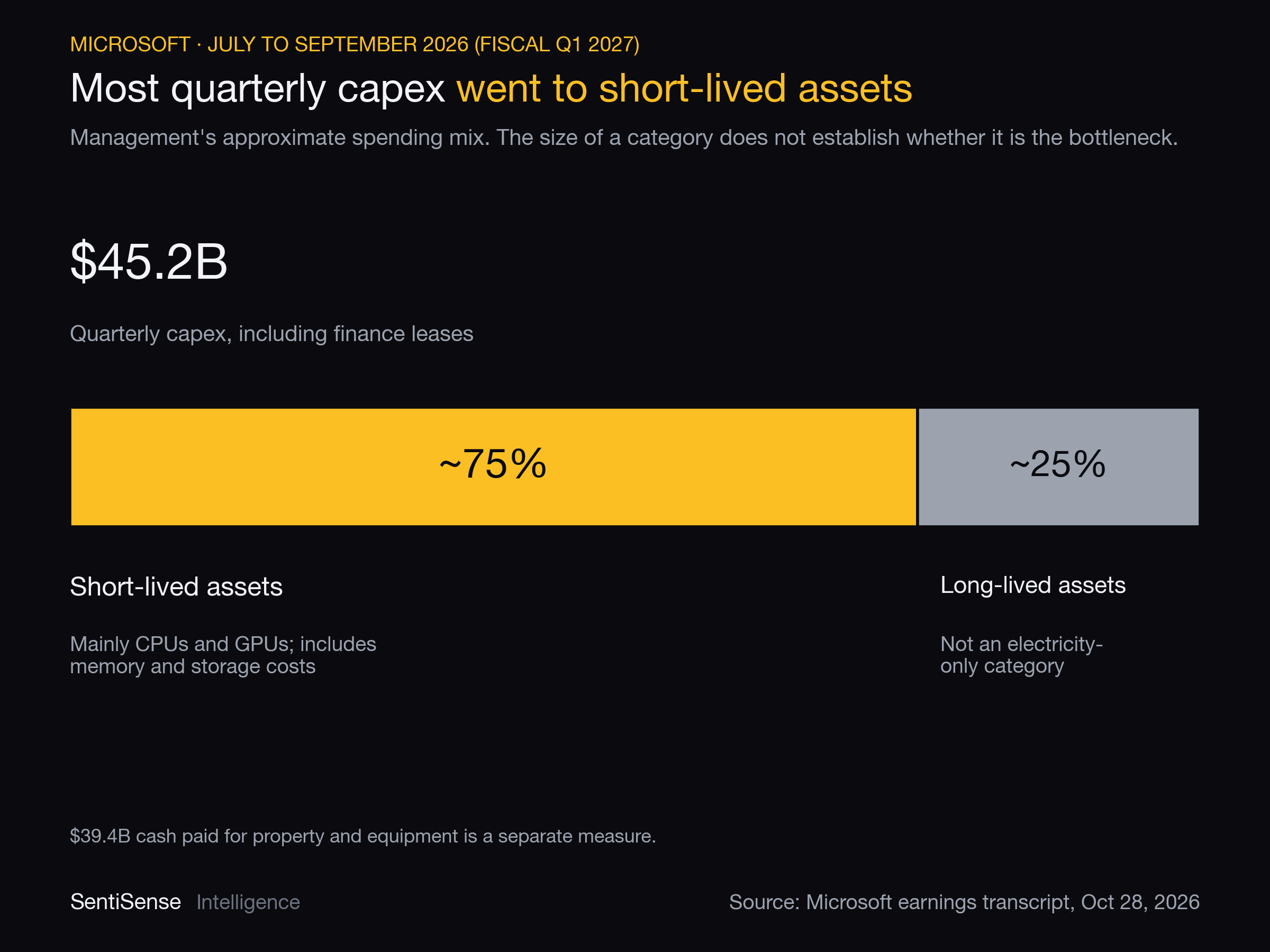
Management's approximate mix of $45.2 billion in quarterly capex, including finance leases. Short-lived assets were mainly CPUs and GPUs, including memory and storage costs. Long-lived assets are not an electricity-only category. Cash paid for property and equipment was a separate $39.4 billion measure. Source: Microsoft, October 28, 2026. Chart: SentiSense.
That mix does not disprove a power bottleneck: a relatively cheap missing grid connection can hold up far more expensive equipment. It does show why calling the whole spending wave an energy investment is misleading. It also shows how easily two true statements get fused into one that is not. Microsoft said some third-party capacity deliveries it expected in the quarter were delayed, and did not name electricity as the cause in that statement. Its filing separately describes regional generation, transmission and distribution constraints that could limit expansion. "Microsoft's delayed capacity was caused by power" goes further than either disclosure.
A power deal needs a delivery date and a definition of new supply. Amazon's Calvert Cliffs agreement with Constellation, announced September 30, is the cleanest example. The agreement covers 690 megawatts. Of that, 190 MW is an uprate, an increase in the existing plant's generating capacity, and that new output is expected between 2030 and 2032.
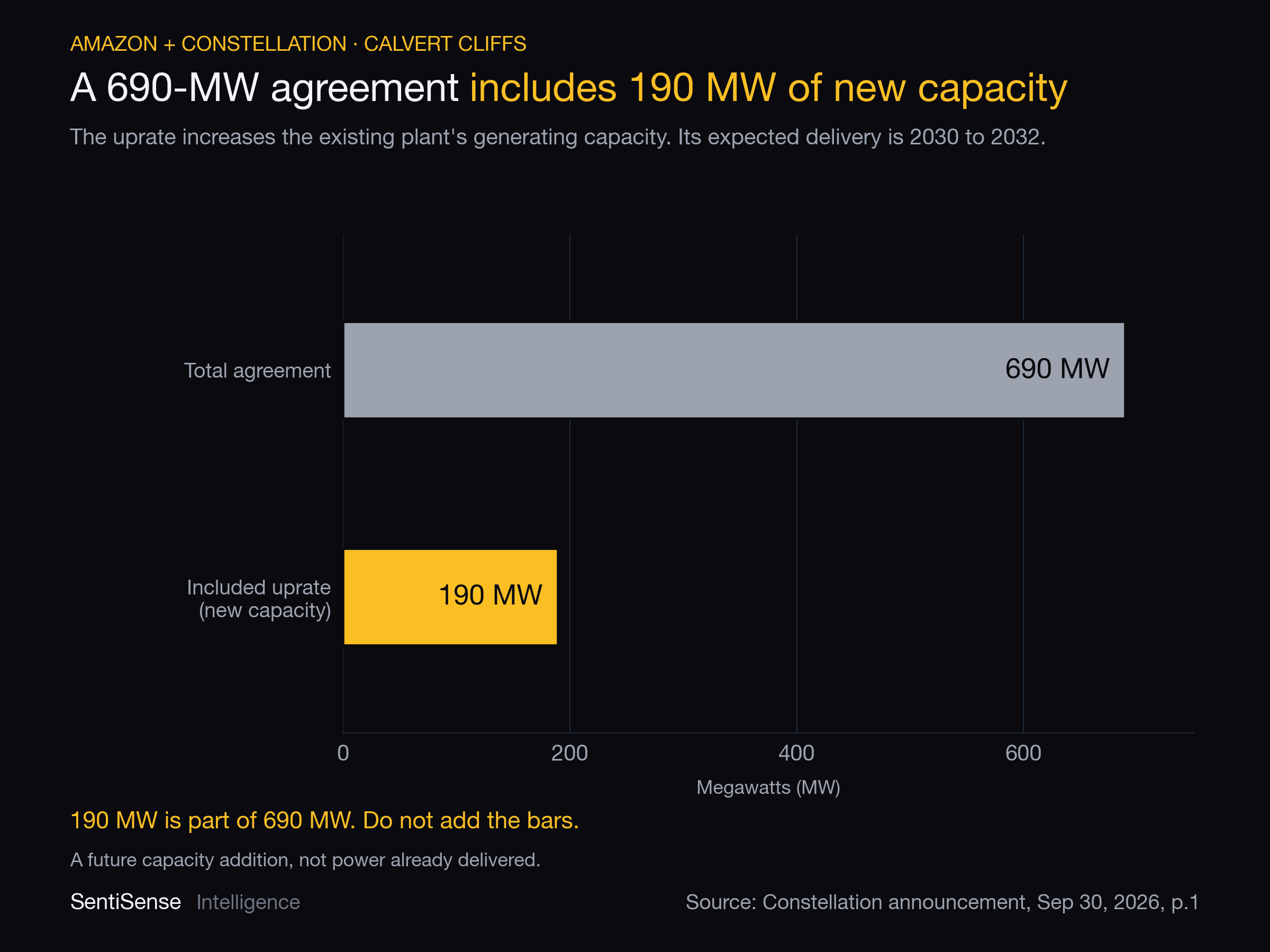
The 190-MW uprate is included in the 690-MW agreement. The two bars must not be added. Only the uprate represents incremental generating capacity, and its delivery is prospective. Source: Constellation, September 30, 2026. Chart: SentiSense.
Buying existing output can lock in supply and support investment in the plant. It does not add the full contracted amount to the country's generating capacity, and Constellation says Calvert Cliffs' electricity will keep flowing to the regional PJM grid, so this is not a dedicated new plant already running for Amazon.
Microsoft's Crane agreement, a nuclear restart, takes a different route: bringing retired capacity back. The original agreement contemplated about 835 MW, and Constellation's August 6, 2026 update targets a 2027 restart, a year earlier than the original 2028 target. It remains a planned restart, and the milestone that matters is the day it delivers, not the day it was signed. An uprate, a restart and a contract for output from an operating plant answer three different parts of the supply problem.
"Six Californias" is real arithmetic for the wrong question. The analogy can be reproduced from public data without treating it as a shortage forecast. EIA's April 2026 baseline projects US annual retail electricity sales rising from about 4,069 TWh in 2025 to 5,575 TWh in 2050, an increase of about 1,506 TWh. Divide the unrounded increase by California's 2024 retail sales of about 245.7 TWh and you get 6.13 Californias. That is our matched-definition calculation, not a reconstruction of any commentator's supply model.
What it measures is economy-wide growth in annual sales by the end year. It is not AI-only demand, and it is not electricity left unserved after new supply is built. As a picture of scale it works; as proof of a shortage it does not.
What would make the power thesis stronger, or weaker. The strongest evidence would be an operator saying, in a filing or on a call, that otherwise-ready compute sat idle for lack of electricity: the site, the affected capacity, the expected connection date and how long the delay ran. That would tie the physical bottleneck to an operating consequence. A risk-factor list, a capex increase or a large contract cannot do that on its own.
The contrary evidence deserves equal weight. Sites with power but missing memory or processors would point to a different immediate constraint. Restarts, uprates and connections arriving ahead of plan would weaken a thesis built on persistent delays. And if capacity comes online and customer use disappoints, the problem has moved again. For the companies supplying the build-out, orders still have to become deliveries, earnings and cash; none of these physical arguments establishes the return on a stock.
Our conclusion. The useful AI energy thesis is about who can deliver usable capacity on time. Power belongs at the center of that analysis, next to the hardware and construction needed to use it. The next disclosure worth reading is a site coming online, a quantified delay being resolved, or a company saying exactly which input is still holding it back. That is the record we would judge the thesis on, and it is measured in megawatts and dates, not in billions.
Dated November 1, 2026. Research and company disclosures through October 29, 2026; forecast publication dates and delivery targets are identified above. Forecasts and targets are conditional. Informational and educational only, not investment advice.
Timeline
INITIAL · Oct 31, 9:32 PM ET
November 1, 2026 analysis, using research through October 29. Company spending and constraints come from Microsoft and Amazon disclosures; electricity estimates and scenarios from the IEA and Berkeley Lab; power-project terms and targets from Constellation. The California comparison uses matched EIA retail-sales definitions. The thesis concerns delivered capacity and makes no stock-price forecast.
Related Stocks
Powered by SentiSense - Intelligent Market Analysis