Apple earnings: a record quarter, a memory-cost margin guide, iPhone Duo crack reports and the touchscreen MacBook
SentiSense Original · Published · Updated · AI-assisted, editor-reviewed
Apple's first quarter under John Ternus was a September-quarter record: revenue of $114.5 billion, up 12%, and diluted earnings per share of $2.10, up 14%, with iPhone up 17% and Services at an all-time high. Our read, dated November 2: the number to hold onto is the guide. Apple expects its best revenue quarter ever in December, at a gross margin of 45% to 46%, mainly on memory costs Ternus calls "unprecedented", with inventories at $14.5 billion against $5.7 billion a year earlier and manufacturing purchase obligations up $33 billion since June. The iPhone Duo is not in these numbers and is supply-constrained; in SentiSense data its bullish share fell from 0.80 before launch to 0.57 over the last seven days, on a durability conversation in which complaints that a real phone cracked are about 13% of what commenters say. The touchscreen MacBook Pro is mocked mostly as an expensive iPad, not for tired arms, and the reviews land November 6.
Apple's first quarter under John Ternus was a record, and the number that matters most in it is the one for the next quarter. Apple reported September-quarter revenue of $114.5 billion, up 12% from a year earlier and a September-quarter record, and diluted earnings per share of $2.10, up 14%, against a consensus of $113.4 billion and $1.99 in SentiSense's earnings calendar. iPhone revenue was $57.6 billion, up 17%; Services reached an all-time high of $31.6 billion, up 10%; Mac rose 24% to $10.8 billion; iPad fell 10% to $6.2 billion and Wearables, Home and Accessories fell 8% to $8.3 billion; Greater China rose 21% to $17.5 billion, a quarterly record. Fiscal 2026 revenue was $479 billion. Gross margin was 47.9%, which Apple says includes about one percentage point from tariff refunds, and the $2.10 includes $0.05 from the same refunds. Then came the guide. For the December quarter Apple expects revenue growth of 7% to 10%, "which reflects our best view of constrained supply", and a gross margin of 45% to 46%, which "includes primarily the impact of higher memory costs, as well as some costs related to the ramp of Siri AI". In the same remarks Parekh added: "We expect this to be the best quarter for revenue in the history of the company". Our read, dated November 2: Apple expects to sell more than ever this quarter and keep less of each dollar, because the memory inside its products costs more, and Ternus says memory pricing keeps rising beyond December. That margin line, not the record, is where a holder should spend the next quarter. Below it, the two products the crowd has been arguing about, the iPhone Duo and the touchscreen MacBook Pro, measured against what people actually said. No forecast for the stock.
What Ternus said about memory, and the two numbers behind it. "It's a privilege to be with you for the first time as Apple CEO," Ternus opened; he took over from Tim Cook on September 1. On costs: "What we're seeing with memory pricing right now is unprecedented". Apple raised prices on Mac and iPad at the end of June and on iPhone in September, a decision Kevan Parekh, the chief financial officer, said the company made "reluctantly"; Parekh also said the quarter's roughly one-point sequential change in margin "was driven entirely by memory impacts". For the December quarter Ternus expects "even higher memory costs, partly offset" by those price changes and by "some benefit from carry-in inventory", a benefit he said Apple expects to decrease over time while "the pricing for memory purchases" keeps rising. Two numbers put a size on that. First, the balance sheet: inventories stood at $14.5 billion on September 26, against $5.7 billion a year earlier, and the cash flow statement shows $8.9 billion of cash going into inventory over the fiscal year, against $1.4 billion coming out of it the year before. Apple does not say in the release what the inventory is. Our reading, and it is ours: a company describing a carry-in inventory benefit on memory, with inventory two and a half times a year earlier, has bought memory ahead of the price rises it expects. The 10-K will say more. Second, the obligations: "our manufacturing purchase obligations have increased by $33 billion from June to the September quarter, which you'll see in our annual filing when it comes out tomorrow". Sabih Khan, the chief operating officer, added that in the December quarter "we expect constraints on Mac and iPad, and it's primarily driven by memory". The 47.9% margin also deserves one subtraction: without the tariff refunds it is about 46.9%, our arithmetic from Apple's own "approximately 1 percentage point", so the 45% to 46% guide sits about one to two points below the quarter just reported on a like-for-like basis. CNBC's live coverage put the revenue guide above the 6.1% growth analysts had expected and the margin guide below a 46.3% average estimate.
The iPhone Duo was not in these numbers, and the crowd's warmth broke after it shipped. The quarter ended September 26; the $1,999 Duo went on sale October 23, so no Duo sale is in the $57.6 billion of iPhone revenue. On the call Khan said "iPhone Duo is constrained as of today" and that "it's really hard to predict when supply and demand will be in balance"; Ternus said Apple is "working hard to get iPhone Duo into customers' hands as quickly as we can". Our October 11 Original graded the Duo the one Apple product that held a bullish share of 0.85 to 0.90 in every window since its September 9 unveiling, and asked whether that would hold "when the people posting about it have one in hand". It did not. In SentiSense data, where each analysis is one news article or social post our models read as bullish or bearish and bull share is bullish divided by bullish plus bearish, the Duo ran 0.80 over October 12 to 22, the pre-launch stretch (520 bullish analyses to 127 bearish), 0.63 since it went on sale (387 to 223, October 23 to November 2) and 0.57 over the last seven days (117 to 88). The on-sale day itself was warm, 0.87 (163 to 24). The four days after it, October 24 to 27, were bear-led, 132 to 149, a share of 0.47, with bearish analyses outnumbering bullish on October 25, 26 and 27. Since October 28 the share has sat at 0.65 (92 to 50): still bull-led, nowhere near September. Those are the days of the crack reports, a bend test, a teardown and Apple's statement; that is co-occurrence we observed, not a cause we tested.
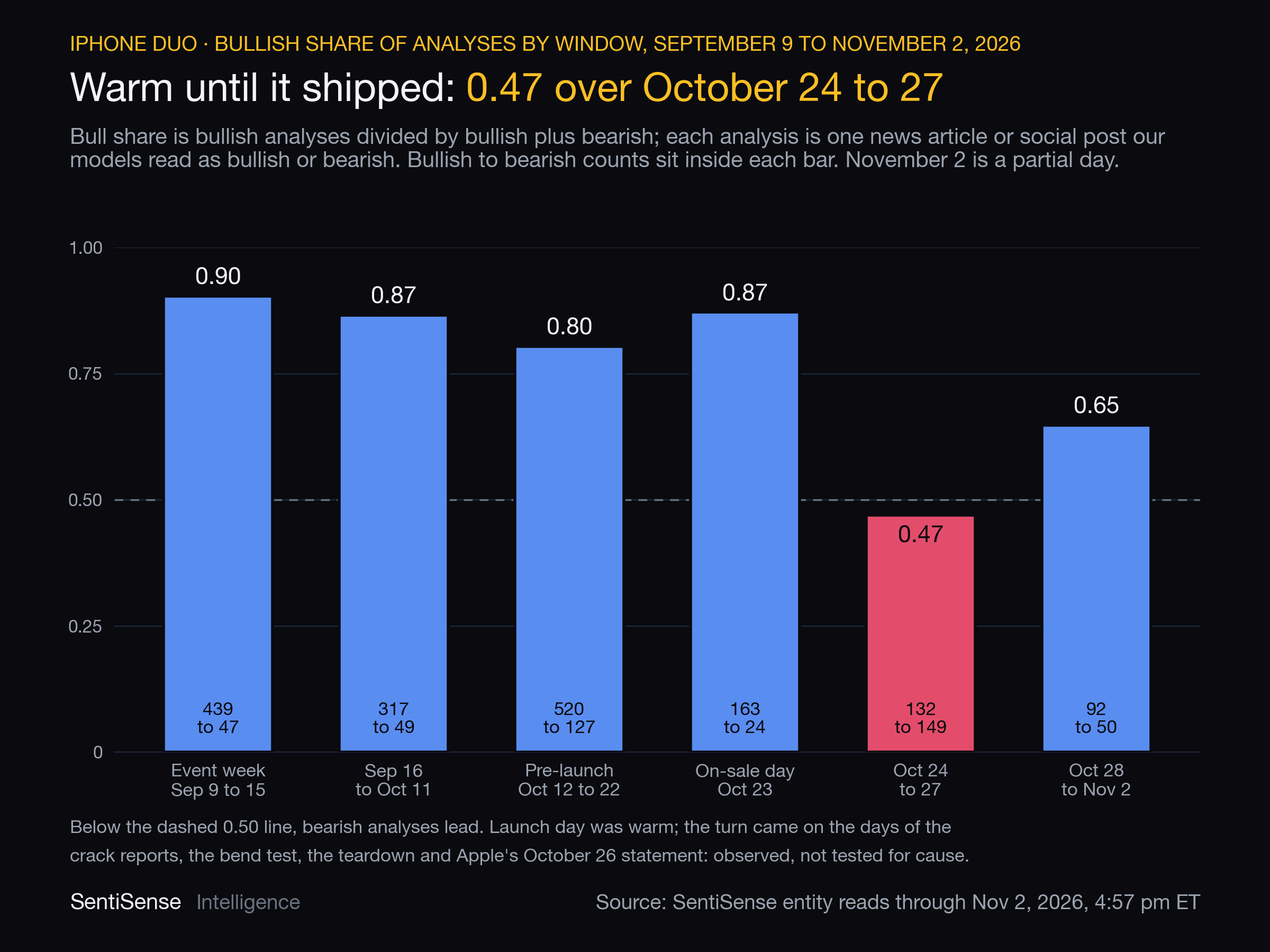
Each analysis is one news article or social post our models read as bullish or bearish; bull share is bullish divided by bullish plus bearish. Windows are New York calendar days; November 2 is a partial day. Opinions about a product, not about Apple's stock. Source: SentiSense entity reads through November 2, 2026. Chart: SentiSense.
What is documented about the screen, and what is not. On October 26 Apple said it "is aware of an issue impacting the inner display on a small number of iPhone Duo units" and told affected owners to contact AppleCare for a replacement. On October 30 MacRumors reported a memo to Apple Stores and authorized service providers advising technicians to inspect the Duo and repair or replace it under standard procedures; Apple said there is no recall and, per MacRumors, that "most iPhone Duo units are not susceptible to this issue". No failure rate has been published anywhere we could read. The counts that exist are small: 9to5Mac tallied "about ten unique instances" on October 25, mostly from Reddit, with cracks along the hinge centerline followed by a row of pixels staying white. Fake and AI-generated crack photos circulated alongside the real cases, and a fact-check caught some of them. The deliberate tests cut both ways. Joanna Stern's fold robot put a Duo through more than 32,000 folds with no failure. JerryRigEverything's unit scratched at level 2 on the inner screen, let dust past the hinge despite its IP68 rating, and came out of the bend test with a permanent green line, which MacRumors summarized as the Duo not surviving. iFixit gave it a provisional 5 of 10, its highest repairability score for a foldable, and wrote that "the breaks cluster near the transition from the gap for the crossing flex cable to the central hinge support"; iFixit, not Apple, is the source for a $999 out-of-warranty inner-display repair. So the honest statement is narrow: a real, acknowledged, unquantified failure cluster on some units; most robots and reviewers did not reproduce it; and nobody outside Apple knows the rate.
What commenters said, counted. We read about 3,200 public comments from TikTok, YouTube and our own Reddit corpus, posted between October 23 and 5 pm ET today under the most-viewed Duo posts, labelled each by topic and tone, and hand-checked a sample (82% agreement on 60 comments). It is a relevance sample, not a census: platforms surface the viral posts, comments under viral posts skew to mockery, and happy owners rarely comment, so these shares describe the loud conversation, not Duo owners. In the neutral-keyword sample, durability (cracks, breakage and stress tests) was the subject of 44% of on-topic comments, more than three times the next topic, and 72% of those comments were negative. But a hand split of 100 of them found only 29 about real-world cracks and defects; 36 were reactions to deliberate tests, many arguing that a fold machine is not a hand; 15 were predictions that it would break; and 11 said the cracks were fake, rare or normal for a first foldable. On that split, complaints that a real phone cracked are about 13% of on-topic comments, not 44%. Stress tests were 140 of the 838 TikTok and YouTube posts in the window that named the Duo, 17% of the posts and 28% of their 626 million views; damage reports were another 22%. More than a third of the durability comments under the stress tests defended the phone. The single most-liked comment in the sample, about 134,000 likes under a news clip on damaged screens, asked how Apple could arrive eight years after Samsung and still not get it right. We could not confirm the claim that people are stress-testing Duos in Apple Stores: 25 captions mention an Apple Store, and none of them describes a test; a test whose caption does not say so would be invisible to us.
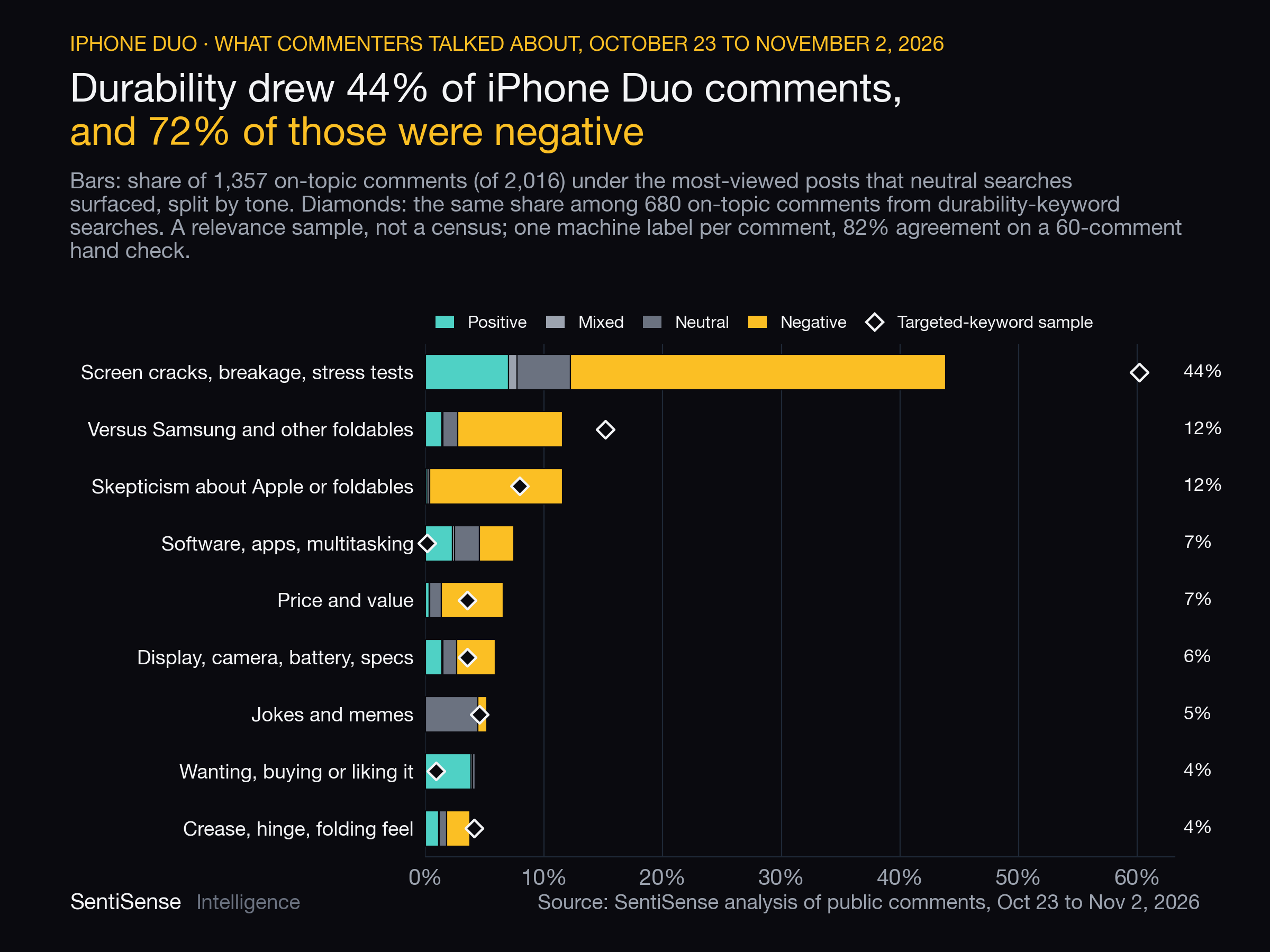
Bars: share of 1,357 on-topic comments (of 2,016) under the most-viewed posts that neutral searches surfaced, split by tone. Diamonds: the same share among 680 on-topic comments from durability-keyword searches. Source: SentiSense analysis of public comments. Chart: SentiSense.
The touchscreen MacBook Pro, and what Steve Jobs actually said. On October 28 Apple unveiled the MacBook Pro with PROLED XDR Display, with "Touch for the first time on Mac", from $2,899, for pre-order that day and arriving November 6. Apple's own framing is specific: touch opens "a whole new dimension for pros to interact with their content, from manipulating 3D models to playing musical instruments onscreen", it works "in tandem with the keyboard shortcuts and trackpad gestures pros know and love", and a new hinge "provides greater stability while using Touch". The release makes no claim about comfort, reach or arm fatigue. The quote everyone is reaching for comes from the "Back to the Mac" keynote on October 20, 2010, about 56 minutes in. Jobs, on vertical touch: "Touch surfaces don't want to be vertical. It gives great demo. But after a short period of time, you start to fatigue, and after an extended period of time, your arm wants to fall off. It doesn't work. It's ergonomically terrible. Touch surfaces want to be horizontal.". That is the whole of it; the phrase gorilla arm, often pinned on him, is other people's. Asked on today's call whether more iOS features are coming to the Mac, Ternus said: "These MacBook Pros are better in every way than the ones that came before them... so we don't have any fundamentally different changes that we're planning right now, nor would we talk about it anyway".
The mockery is real, and it is not mostly about arms. In the same comment exercise, run over about 1,900 TikTok, YouTube and Reddit comments from October 28, Steve Jobs references were 7% of on-topic comments, and 89% of those were negative, nearly all a version of "he was right". Ergonomics was another 7%, and most of it was about fingerprints and smudges, not fatigue; comments about tired arms, reach or posture were under 2% of the neutral sample. The bigger topics were the display and the glowing Apple logo (22%, the one topic close to balanced), "it is just an iPad" or "Windows had this for years" (18%, 78% negative), price (17%, 70% negative) and whether touch on a laptop is useful at all (13%, 55% negative). Overall, 60% of on-topic comments were negative and 19% positive. The press split the same way: of twelve pieces we read from October 28 to November 1, two were critical, five mixed or price-skeptical, two supportive and three neutral. CNBC's hands-on called touch "entirely optional"; Engadget judged the touch models "probably aren't worth the higher $400 base price for most people"; TechRadar wrote that Apple "has completely sidestepped the entire issue of arm fatigue"; Gizmodo's answer to who it is for was that "MacBook trackpads are just too good". None of them is a review. The machines ship November 6, and the reviews land with them. In our own data the Mac entity has run warm since the unveil, a bull share of 0.85, but it pools every Mac, including the non-touch M6 MacBook Pro announced October 27, so it cannot isolate touch and we do not lean on it.
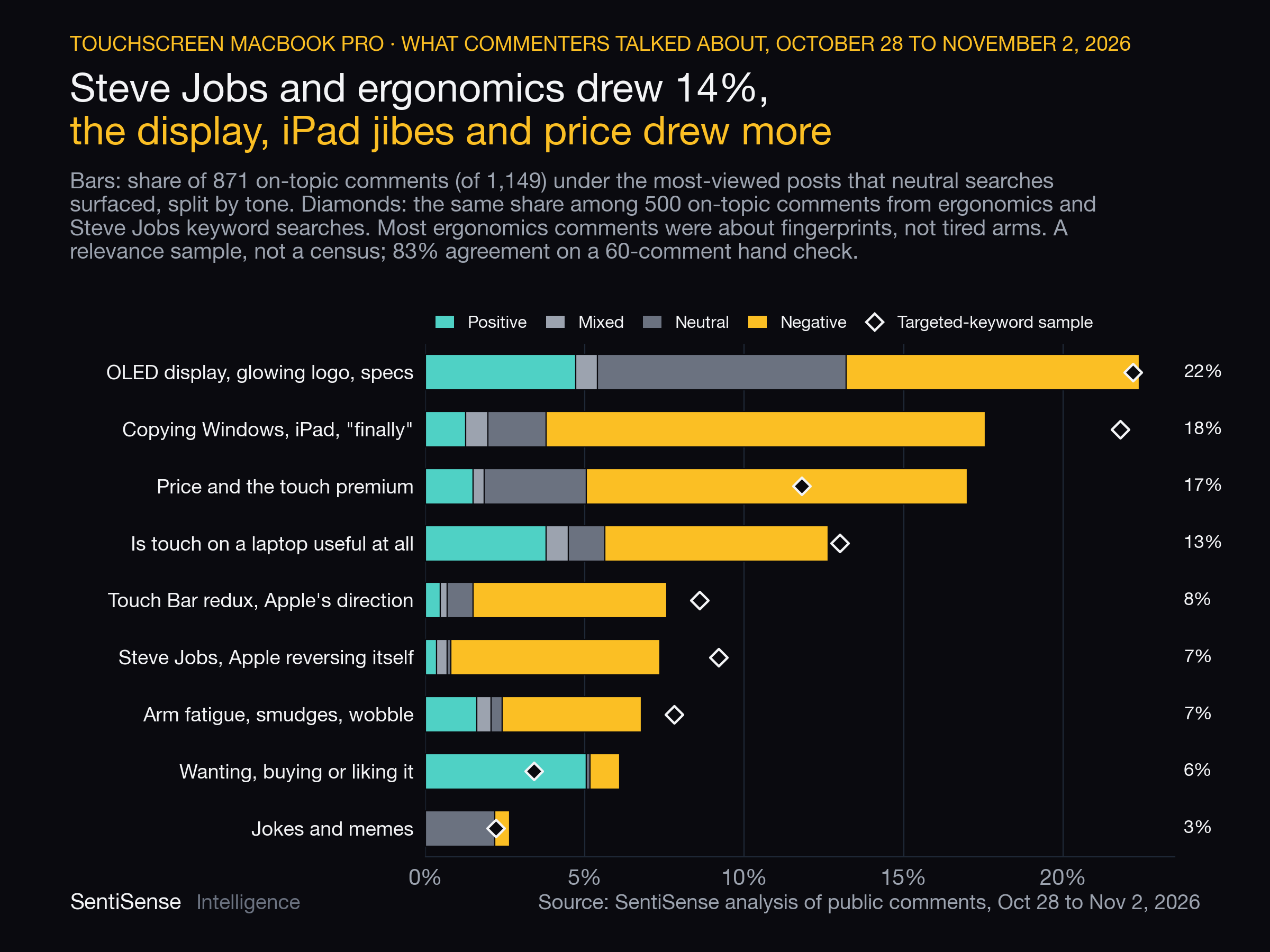
Bars: share of 871 on-topic comments (of 1,149) under the most-viewed posts that neutral searches surfaced, split by tone. Diamonds: the same share among 500 on-topic comments from ergonomics and Steve Jobs keyword searches. Source: SentiSense analysis of public comments. Chart: SentiSense.
What would settle it. Four checkpoints, in the order they arrive.
1. November 3, the 10-K. The manufacturing purchase obligations Ternus says rose $33 billion from June to September, and whatever the filing says about the $14.5 billion of inventory. Obligations that are mostly memory at agreed prices would mean Apple has locked in a cost it already knows; open-ended ones would make the 45% to 46% a guide only as good as the memory market. 2. November 6, the touchscreen MacBook Pro reviews. The two questions the comments and the hands-on pieces raised: whether people use touch on a laptop at all after the first week, and whether the premium over the non-touch models buys anything the trackpad does not. 3. The December-quarter report, early in the new year. Revenue against 7% to 10%, gross margin against 45% to 46%. A print at or above 46% would say the price increases and the carry-in inventory covered the memory bill; below 45% would say they did not, and the carry-in benefit is one Apple has already said shrinks from here. 4. Duo supply and the failure cluster. Khan could not say when supply meets demand. What would change the Duo reading: a published repair program or recall (there is none), a collapse in shipping times, or a reviewer's long-term unit failing in normal use rather than under a bend rig.
Our conclusion. The quarter was a record on Apple's own definition, and the guide says what Apple is watching: memory, priced at levels its chief executive calls unprecedented, bought ahead with $8.9 billion of inventory build and $33 billion of new purchase obligations. The Duo is not in the numbers, is supply-constrained, and lost the crowd's warmth after it shipped, on a durability conversation in which real crack complaints are a minority of what people say and Apple's acknowledged failure is "a small number" without a rate. The touchscreen Mac is mocked, mostly as an expensive iPad rather than as an arm-fatigue machine, and nobody has reviewed one yet. We are not forecasting the stock.
Dated November 2, 2026. Apple's results and earnings call of November 2; SentiSense entity reads and the public-comment sample through November 2, 5 pm ET. Informational and educational only, not investment advice.
Timeline
INITIAL · Nov 2, 6:57 PM ET
November 2, 2026 analysis, written the evening of Apple's fiscal fourth-quarter report. Results from the 8-K exhibit; the December-quarter guide and every call quote from the earnings call transcript; iPhone Duo and touchscreen MacBook Pro facts from Apple's own releases and statement and the cited reporting; SentiSense entity reads and the public-comment sample through November 2, 5 pm ET. The piece makes no stock-price forecast; the next checkpoints are the 10-K on November 3, the touchscreen MacBook Pro reviews on November 6, and the December-quarter report against the 7% to 10% revenue and 45% to 46% gross-margin guide.
Related Stocks
Powered by SentiSense - Intelligent Market Analysis