Apple is last to market twice this fall. The foldable is winning the crowd. The iPhone 18 Pro Max is losing it
SentiSense Original · Published · AI-assisted, editor-reviewed
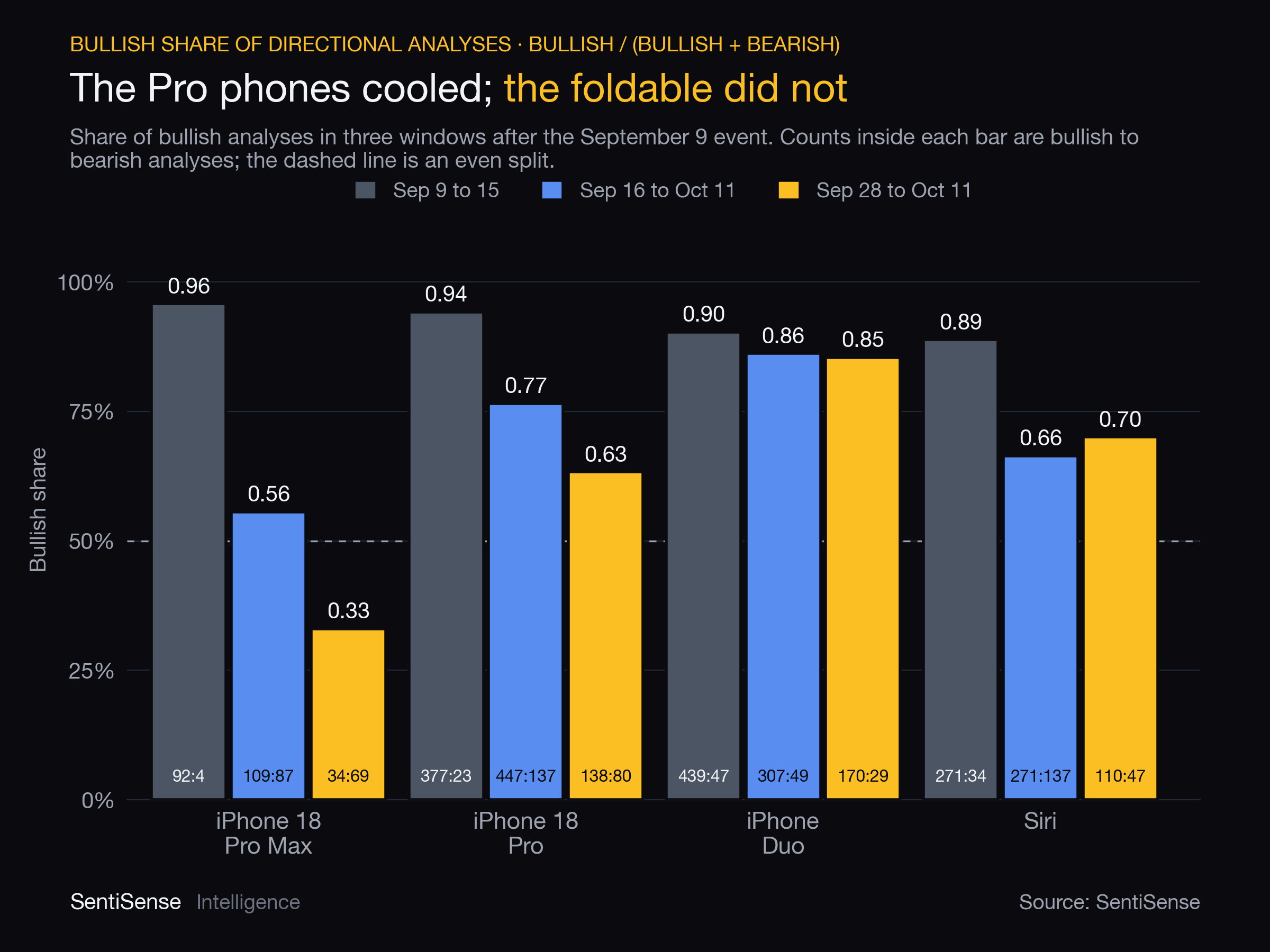
Apple's first foldable, the $1,999 iPhone Duo unveiled September 9, is the one Apple product in SentiSense data that held a bullish share above 0.85 in every window: 0.90 in event week (439 bullish analyses to 47 bearish), 0.86 since and 0.85 over the last two weeks, on more event-week attention than any other Apple device or feature we track. The rebuilt Siri that shipped in beta on September 14, with models Apple says were built in collaboration with Google and its Gemini models, drew its loudest day in 90 days, 166 mentions and 107 bullish to 10 bearish, and runs warmer than AAPL in every window, while reviewers describe silently dropped requests and "sorry, something went wrong". The product that went cold is the $1,299 iPhone 18 Pro Max: 0.96 in event week to 0.33 over September 28 to October 11 (34 bullish to 69 bearish), turning on October 2, the day Apple confirmed a cellular defect on some Pro Max units on AT&T, a week before Nikkei Asia reported Pro component order cuts of at least 15%. AAPL closed at $336.64 on October 9, 6.8% above its event-day close, with its own coverage split 236 bullish to 211 bearish since October 1.
Marc Andreessen put Apple in the category of what "Peter Thiel calls last to market" and warned that "there's a fine line between that strategy and just simply becoming obsolete." He said it in an August 2025 interview, and this fall Apple ran the play twice. On September 9 it unveiled its first foldable, the $1,999 iPhone Duo, seven years after Samsung's first Galaxy Fold went on sale. On September 14 it shipped a rebuilt Siri, in beta, about a month after xAI opened its Grok Bot beta, six days after Meta launched Muse and fifteen days before OpenAI launched Dots. We graded both against our own data, where each analysis is one news article or social post our models read as bullish or bearish. The foldable is the one Apple product we track that stayed warm in every window. Siri's welcome was warm too, warmer than the coverage of AAPL itself. And the product that went cold is neither of the late ones: it is the $1,299 iPhone 18 Pro Max.
The crowd is rewarding the wait on the foldable. The iPhone Duo opens to a 7.6-inch display, closes to a 5.4-inch one, starts at $1,999, takes preorders on October 16 and goes on sale October 23. In the week of the event it drew 778 mentions, more than any other Apple device or feature we track, against 626 for the iPhone 18 Pro and 538 for Siri, and its coverage ran 439 bullish to 47 bearish, a bullish share of 0.90. The share has barely moved since: 0.86 from September 16 to October 11 (307 to 49) and 0.85 over the last two weeks (170 to 29). No other Apple entity in our data stayed above 0.85 in all three windows. Outside our data, Gene Munster of Deepwater expects about 20 million Duo units in the first year against a consensus near 10 million; that is an analyst estimate, not a sales figure.
The cold product is the one Apple sells every year. The iPhone 18 Pro and Pro Max cost $1,199 and $1,299, $100 above last year's models, a rise that came amid the AI-driven memory chip costs Apple has cited for its recent price increases, as MacRumors reported. Both left the event warm and both cooled. The Pro went from a bullish share of 0.94 in event week (377 to 23) to 0.77 in the weeks after it to 0.63 over the last two weeks (138 to 80), still bull-led. The Pro Max went from 0.96 (92 to 4) to 0.56 to 0.33, where bearish analyses lead 69 to 34; from October 1 to 11 it is 24 bullish to 65 bearish. It turned before the Nikkei news did, and on a defect. On October 2 the Pro Max drew 50 mentions and ran 7 bullish to 27 bearish, the day Apple told 9to5Mac it had identified an issue affecting "a small number of iPhone 18 Pro Max users on the AT&T network" that may cause a device to lose service and be unable to make calls; devices that had already lost service "will require a hardware replacement", and iOS 27.0.1 with a carrier settings update prevents it on others without restoring service. The X posts from October 1 to 3 that we reviewed were dominated by that defect, not by price, heat or battery. Our counts coincide with it; we do not claim they measure it. A week later, on October 9, Nikkei Asia reported that Apple had asked suppliers to cut October component orders for the Pro line by at least 15%, citing memory costs, the higher prices and a split launch that, by MacRumors' account, holds the standard iPhone 18 until spring 2027. Apple has not commented on the report. An order cut is not a sales number, and one Apple-watching site called the report Nikkei's annual production-cut story. Our feed's version of it read negative at -0.56, and that day the iPhone 18 Pro drew 74 mentions, 26 bullish to 38 bearish.
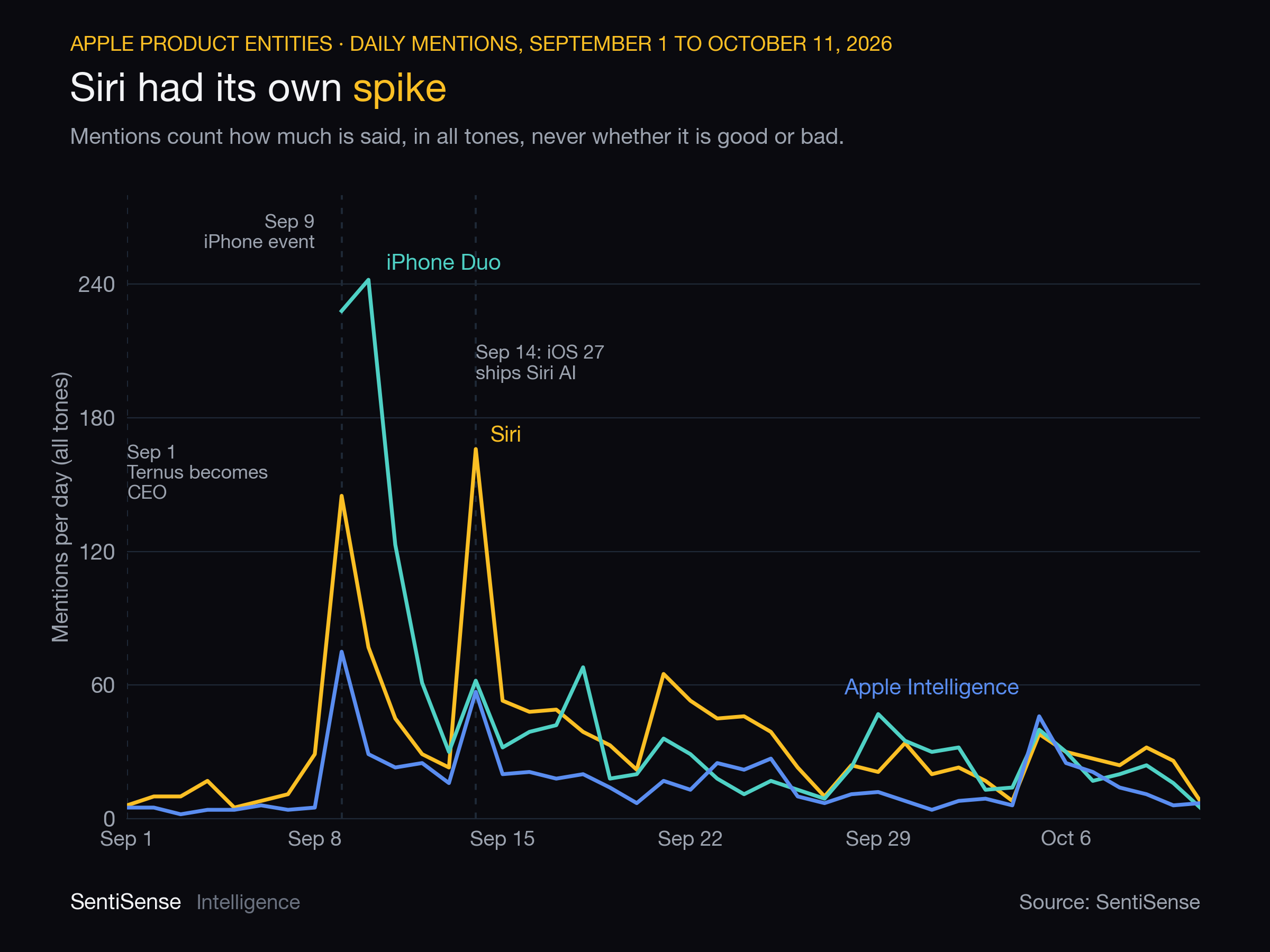
Siri's welcome was warm, and it was for the promise. Siri AI began rolling out in beta on September 14 with iOS 27, in English, not initially in the EU, not in China, with daily limits on its server-side features and "expanded access" that Apple says "will be available for a fee in the future". That was Siri's loudest day of the ninety we track: 166 mentions, 107 bullish analyses to 10 bearish. Over event week its bullish share was 0.89 (271 to 34); over 90 days it is 0.74 (793 to 277), above AAPL's 0.63, and it stays above AAPL in every window we tested. On X, where AAPL itself reads flat at -0.02, Siri reads as warm as the press: a mean polarity of +0.25 over 45 days against +0.29 in the news. The cool voices on Siri are Reddit and Hacker News, both at -0.07, and together they are about one mention in eight. The reviews explain the distance between warm and reliable. Dan Moren at Six Colors found Siri AI "capable: impressively so, at times", wrote that it "largely delivers on what the company promised", and also that it "sometimes misunderstands or gives confidently wrong answers", once filing a calendar event "at the wrong time and in the wrong timezone". MacStories wrote that "Apple's belated effort has paid off, but there's still so much work to be done", that "if I ask for three things in the same question, the third one will be silently dropped", and that "sorry, something went wrong" messages persist. A sample we reviewed of about 20 first-hand Siri posts on X leaned the same way: roughly 11 to 12 complaints, "something went wrong" errors, slowness and misheard commands, against about 7 posts of praise. One user wrote that it "can't even do basic tasks like setting timers, checking the weather, or texting people without either 'something went wrong' appearing, or just cutting out mid-answer"; another, that "Siri AI impressed me today". It is a small sample, and much of the warmer X conversation relayed the launch itself, which fits a welcome for the promise.
Apple holds the best position in the category and has not yet shown it can use it. Apple describes Siri AI as drawing on personal context across a user's messages, email and photos, with onscreen awareness and the ability to take actions inside apps. That is the asset nobody else can rent: the phone is where a person's life already sits. The rivals are cloud agents on subscriptions. Meta's Muse launched in the US on September 8, sends email, books travel and fills forms, and reached No. 1 on the US App Store's free chart ahead of ChatGPT, with about 730,000 downloads in its first five days by Sensor Tower's estimate. OpenAI's Dots, launched September 29, are always-on agents on GPT-6 Astra, each with its own cloud computer, for Pro and Business Premium subscribers. xAI's Grok Bot has been in beta since August 11 as a team of always-on agents sold inside the SuperGrok tiers, by xAI's own description. None of them is a phone. But an assistant's test is whether it does the thing, and the models Apple built to do it were, in Apple's words, "custom-built in collaboration with Google and its Gemini models", the same Google that introduced Gemini Intelligence for Android in May and said it is coming to Galaxy and Pixel phones. Being last to market with a product you designed yourself is one bet, and the Duo is that bet. Being last with an engine licensed from the rival on the other platform is a different one, and that fine line runs between the two. Our data grades the welcome. The reviews grade the reliability, and they say it is not there yet.
The new CEO is the quiet part of the story. John Ternus became chief executive on September 1, a change Apple announced on April 20, with Tim Cook moving to executive chairman. AAPL closed at $325.13 that day, up 2.61% from $316.85; that is the stock's own number, and we do not assign it a cause. It was also Ternus's loudest day in our data, 109 mentions, 13 bullish to none bearish. In event week he drew 157 mentions to Siri's 538, and his directional samples are too small to grade in any window (66 bullish to 11 bearish across the whole 90 days), so we print attention, not tone. The sharpest leadership story on our AAPL driver list was a Bloomberg report on September 29 on a leaner organization under him, which our feed read at -0.36. The AI bench he inherits has lost people: John Giannandrea's retirement was announced in December, and Bloomberg reported in January that more AI researchers and a Siri executive had left. The Siri that shipped in his second week was built before he had the job. The next one is his.
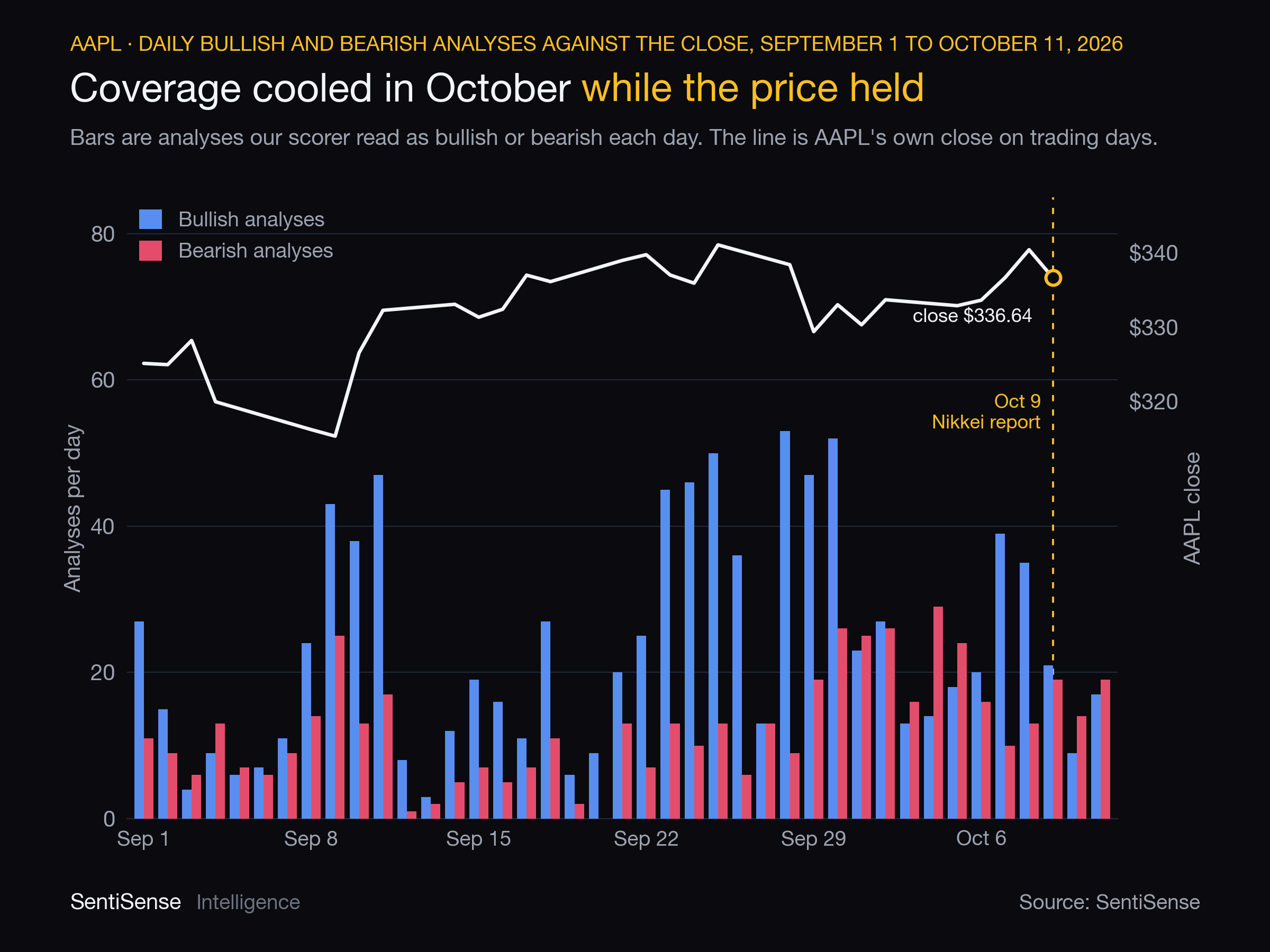
The stock did not follow the coverage. AAPL closed Friday, October 9, at $336.64, down 1.11% on the day of the Nikkei report after falling more than 2.5% early in the session. That is 6.8% above its September 9 event-day close of $315.34 and $8.70 below its 52-week intraday high of $345.34. Over the same stretch AAPL's own coverage cooled: from October 1 to 11 it ran 236 bullish to 211 bearish, a share of 0.53, after 0.71 in event week and 0.65 from September 16 to October 11. October 3 and 4 were bear-led, 13 to 16 and 14 to 29, and on the day of the Nikkei report the split was 21 to 19. Over the full 90 days AAPL was bull-led on 61 days, against 68 for Siri and 85 for the iPhone family, the least consistently warm of the three. The press is warmer than the crowd on the stock: the news mean polarity over 45 days is +0.25, X is -0.02 and Reddit -0.10, in a conversation that is about two-thirds news. The mean analyst target in our data, $328.09 across 39 analysts, sits below Friday's close, inside a consensus of Buy (25 buy, 13 hold and 6 sell among 44 rated). We set tone and price side by side and do not draw the line from one to the other.
The dates, in order.
April 20, 2026: Apple announces Ternus as CEO from September 1 and Cook as executive chairman. August 11: xAI opens the Grok Bot beta. September 1: Ternus takes over; AAPL closes at $325.13, up 2.61%. September 8: Meta launches Muse in the US. September 9: Apple unveils the iPhone 18 Pro at $1,199, the Pro Max at $1,299 and the iPhone Duo at $1,999; AAPL closes at $315.34. September 14: iOS 27 ships with Siri AI in beta; Siri's loudest day in our data, 107 bullish to 10. September 29: OpenAI launches Dots; Bloomberg reports a leaner organization under Ternus. October 2: Apple confirms to 9to5Mac a cellular defect on some iPhone 18 Pro Max units on AT&T, with hardware replacements for devices that lost service; the Pro Max runs 7 bullish to 27 bearish on 50 mentions. October 9: Nikkei Asia reports October component orders for the iPhone 18 Pro line cut by at least 15%; AAPL closes at $336.64, down 1.11%. Ahead: Apple's "Welcome home" launch on Tuesday, October 13, where Macworld expects a new home hub plus Apple TV and HomePod mini updates with chips suited to run Siri AI; iPhone Duo preorders October 16, on sale October 23; fiscal fourth-quarter earnings on Monday, November 2, per Apple's investor relations as reported by MacTrast.
What would change our read. Andreessen's other line from that interview was that "there's a lot of survivorship bias in these kinds of strategy discussions": the companies that waited and never caught up are not the ones studied, and a crowd read can only grade products that shipped. Three things, each dated. First, whether the Duo's bullish share holds through preorders on October 16 and deliveries from October 23, when the people posting about it have one in hand; every window so far is an opinion about an announcement. Second, whether Siri's share, 0.70 over the last two weeks (110 to 47), survives the end of the beta's novelty and whatever Apple charges when the fee arrives; a late winner in assistants is measured in requests completed, and a rented engine is still a dependency however good it gets. Third, whether the Pro Max's 34 to 69 is a verdict on a $1,299 phone or on a defect Apple says it has contained; the November 2 call is the first time Apple speaks to iPhone demand on the record, and it has not commented on the Nikkei report.
SentiSense data as of October 11, 2026, through Friday's close. Informational and educational only, not investment advice.
Timeline
INITIAL · Oct 11, 5:30 PM ET
Published Sunday, October 11, 2026, two days after Nikkei Asia reported cuts to iPhone 18 Pro component orders and five days before iPhone Duo preorders open. AAPL closed Friday at $336.64, 6.8% above its September 9 event-day close and $8.70 below its 52-week high. Figures are SentiSense entity reads on Apple, Siri, Apple Intelligence, the iPhone Duo, the iPhone 18 Pro and Pro Max, John Ternus and Tim Cook, AAPL's own closes, and the cited reporting, through October 11.
Related Stocks
Powered by SentiSense - Intelligent Market Analysis