Sandisk stock split: 8-for-1 changes the share count, not the business. The 378% quarter was price, not volume
SentiSense Original · Published · Updated · AI-assisted, editor-reviewed
Sandisk's 8-for-1 split gives each holder eight shares for one on November 20 and changes nothing about what they own: the company says market value and ownership percentages are unaffected. Our read, dated November 2: the argument worth having is about the quarter, not the split. Revenue rose 378% to $11.03 billion, but products sold rose almost 10% in exabytes, so the gain was almost all price. Sequential growth stepped down from 97% to 23%, and the $12.2 billion to $12.6 billion guide implies 11% to 14%, with gross margin guided flat. The stock closed 13.5% lower on October 30, up 385% in 2026 and 51% below its June 25 high. Sandisk's own filings supply both the price-cycle case and the durability case.
Sandisk's 8-for-1 split hands every holder eight shares for one on November 20, and changes nothing about what they own. Sandisk said so itself in the October 29 announcement: overall market capitalization and stockholder ownership percentages will not be affected by the split. The number worth arguing about sits in the same release and in the 10-Q filed the next day. Revenue for the quarter ended October 2 rose 378% from a year earlier, to $11.03 billion, while the volume of product sold rose by almost 10% on an exabyte basis. Almost all of the 378% is price. Our read, dated November 2: a holder should spend no time on the split and all of it on how long a price cycle like this one lasts, because quarter-over-quarter growth has already stepped down from 97% to 23%, and the guide for the current quarter implies 11% to 14%. Sandisk's own filings supply the evidence for both sides of that argument, and we lay it out below without a forecast for the stock.
That is the order of importance. A split is a unit change, the way a price per gigabyte and a price per terabyte describe the same thing. The quarter is a statement about what customers paid for a byte of NAND flash, and the guide is a statement about where that price is heading next.
What the 8-for-1 split changes, and what it does not. The terms come from the 8-K filed October 29. Stockholders of record at the close of business on November 9 receive seven additional shares for each share held. The new shares are issued after the market close on Thursday, November 19, and the stock is expected to trade on a split-adjusted basis from the open on Friday, November 20, under the same ticker. The charter amendment raises authorized shares from 450 million to 3.6 billion. Sandisk gives one reason: to make the stock more accessible, including to employees through its stock purchase plan.
The arithmetic is the whole effect. At the October 30 close of $1,150.89, one pre-split share becomes eight shares of about $143.86 each, our division. The 10-Q restates the quarter as if the split had already happened: the same $8.10 billion of net income spread over 1,232 million diluted shares is $6.58 a share instead of $52.60. The guide of $55.00 to $57.00 in non-GAAP earnings per share is on a pre-split basis; divided by eight it is about $6.88 to $7.13. Nothing in that list changes the value of a holding, the company's cash, its contracts or its share of the NAND market. A lower share price does not make the stock cheaper on any multiple, and a holder who follows the ticker through November 20 should expect a print near $144, not a collapse.
The 378% was mostly price. Volume rose about 10%. The 10-Q's revenue discussion separates the two. Net revenue rose 378%, or $8.7 billion; total products sold rose by almost 10% on an exabyte basis. On our arithmetic from those two figures, revenue per gigabyte across the company more than quadrupled. The three end markets tell different stories. Datacenter revenue rose 1,685%, to $4.80 billion from $269 million, on almost 330% more exabytes and almost 320% more revenue per gigabyte: the one end market where volume and price both rose, and the only one Sandisk attributes to higher sales as well as higher pricing. Edge, the flash sold into PCs, phones and other devices, rose 320% to $5.83 billion "primarily due to higher pricing": revenue per gigabyte rose by more than 450% while exabytes sold fell 20%. Consumer, the retail cards and drives, fell 39% to $397 million, with exabytes down more than 70% and revenue per gigabyte up more than 110%.
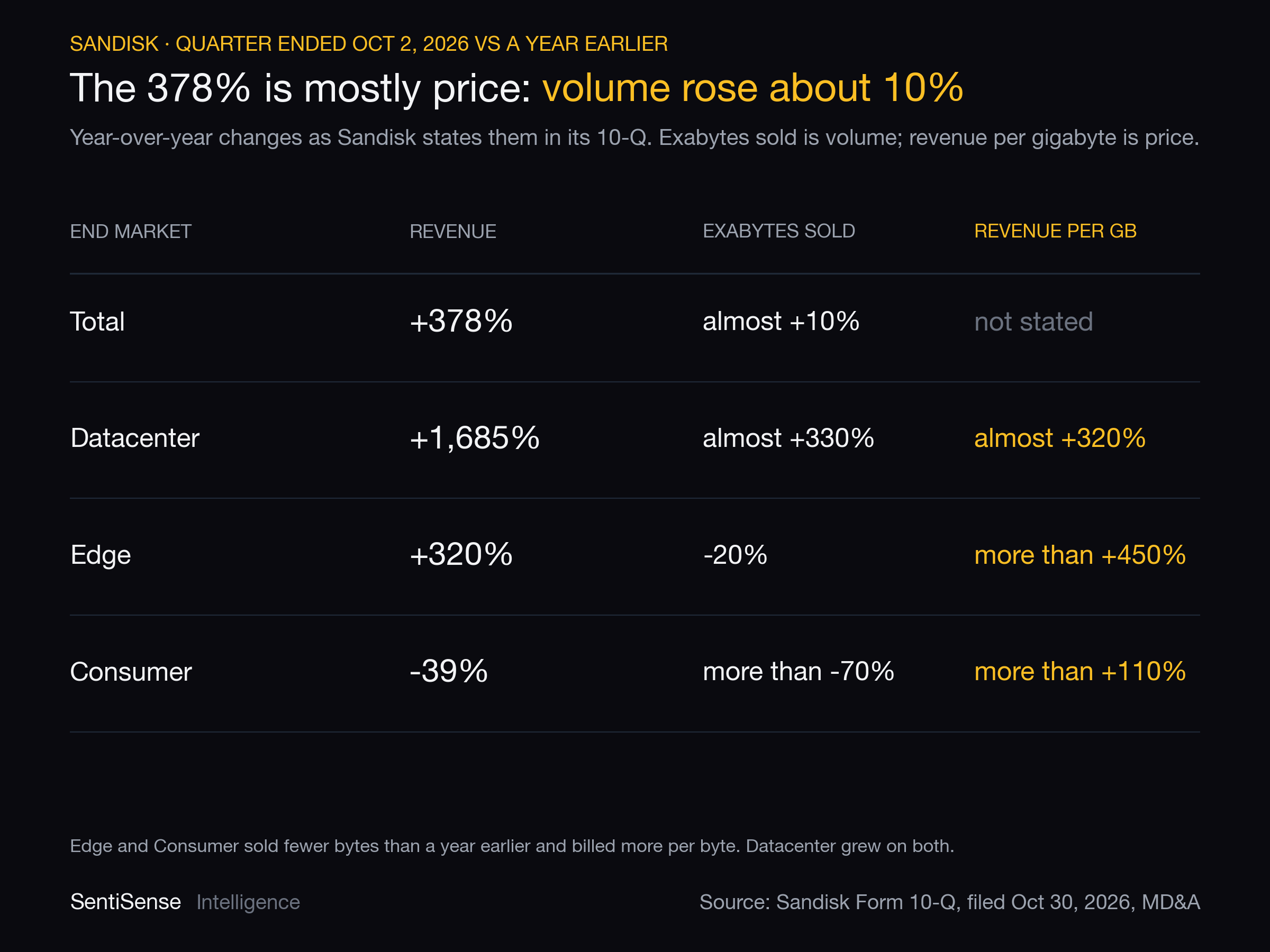
Year-over-year changes for the quarter ended October 2, 2026, as the 10-Q states them; "almost" and "more than" are the filing's own qualifiers. Sandisk does not state a company-wide change in revenue per gigabyte. Source: Sandisk Form 10-Q, October 30, 2026. Chart: SentiSense.
So in two of Sandisk's three end markets, the company sold fewer bytes than a year earlier and billed far more for each one. Gross margin went from 29.8% to 85.0%, which the 10-Q attributes primarily to higher revenue per gigabyte and more exabytes sold. The filing also says the environment "led to pricing and product mix shifts, including strategic decisions about how we allocate products to customers across the end markets we serve". Read plainly: Sandisk is choosing who gets its flash, and at what price. For what Sandisk makes and where NAND sits beside DRAM and high-bandwidth memory in an AI data center, our explainer on HBM, DRAM, NAND and hard drives has the map. The short version from the 10-K: all of Sandisk's flash wafers come from its joint ventures with Kioxia, it buys DRAM as a component, and it does not offer DRAM, so it makes no HBM.
Sequential growth has stepped down, and the guide steps it down again. Revenue by fiscal quarter ran $2.31 billion in the quarter to October 3, 2025, $3.03 billion to January 2, 2026, $5.95 billion to April 3, $8.97 billion to July 3 and $11.03 billion to October 2. Quarter over quarter, that is growth of 31%, 97%, 51% and 23%, our arithmetic. The guide for the quarter to early January 2027 is $12.2 billion to $12.6 billion, 11% to 14% above the quarter just reported, with non-GAAP gross margin guided to 84.5% to 85.5% against the 85.1% just printed.
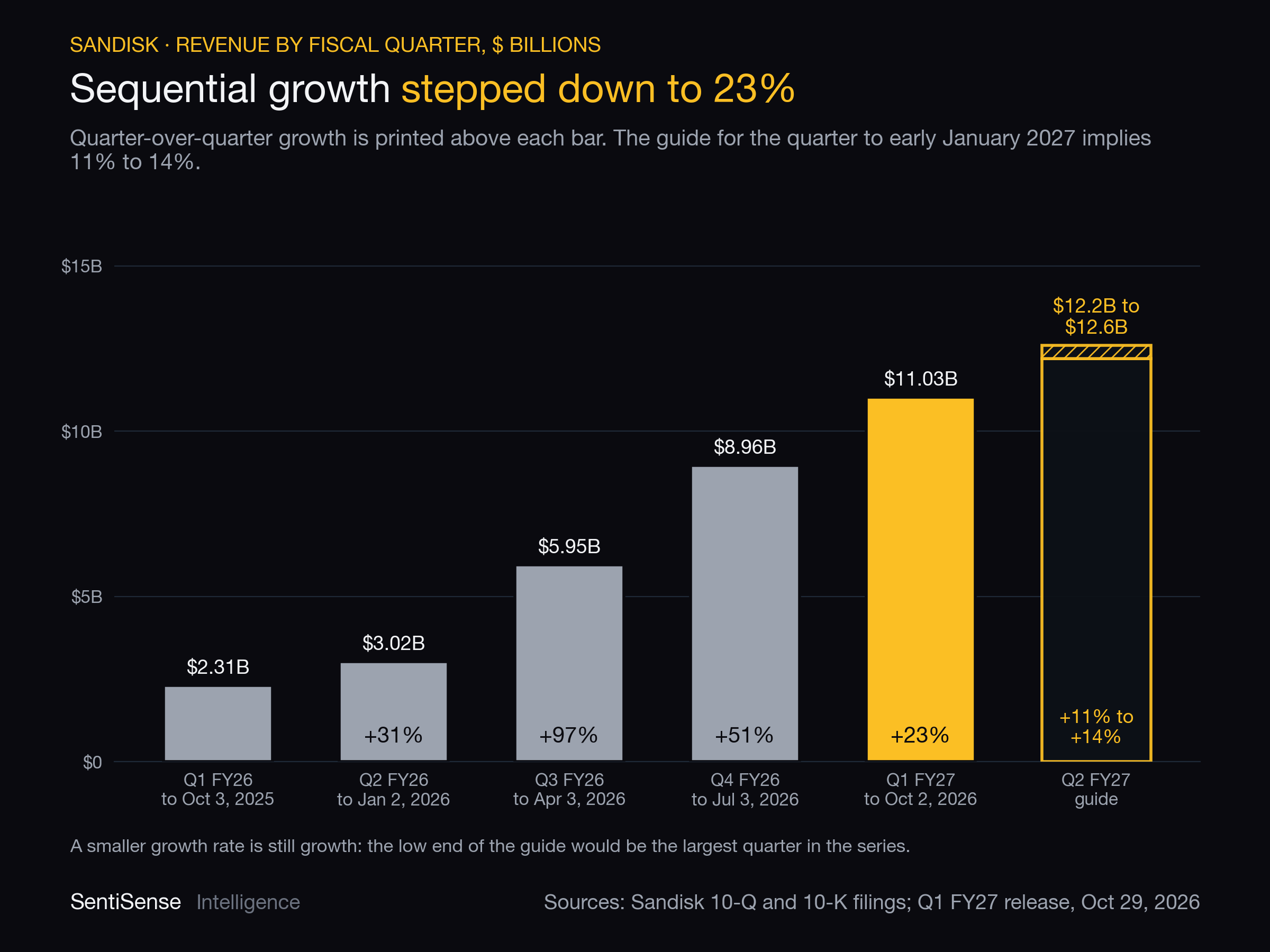
Revenue by fiscal quarter in $ billions, with quarter-over-quarter growth. The hatched segment is the top of the $12.2 billion to $12.6 billion guide for the quarter to early January 2027. Sources: Sandisk 10-Q filings and the October 29, 2026 release. Chart: SentiSense.
Two readings of the same numbers. The first: $12.2 billion would still be the largest quarter in the series, gross margin is guided flat at a level that was 30% a year ago, and the company returned $5.0 billion through buybacks in the quarter and has repurchased 6.0 million shares over two quarters, about 4% of shares outstanding. The second: the growth rate has fallen for two quarters in a row, the guide implies a third, and a gross margin guided flat means the gap between what Sandisk charges for a byte and what a byte costs it has stopped widening. The guide does not split its 11% to 14% between price and volume; the next 10-Q will. Both readings are true at once, and the stock's reaction on October 30 does not tell you which one the market chose. It tells you only that the stock fell.
The fall is bigger than one day, and smaller than the year. From our daily closes: Sandisk ended 2025 at $237.38, closed at its 2026 high of $2,335.00 on June 25, closed at $1,330.05 on October 29 and at $1,150.89 on October 30. The October 30 move is a 13.5% fall. At that close the stock was up 385% in 2026 and 51% below the June 25 high, having already given back 43% before the quarter was reported. The other memory and storage names fell the same day, each by its own closes: Micron 5.3%, Western Digital 7.4% and Seagate 8.0%. We do not know why any seller sold, and no filing says. In SentiSense's analyst feed, the six actions dated October 30 were all reiterations, from Equal-Weight and Sector Perform to Buy and Outperform, with no upgrade or downgrade. Mentions of Sandisk in our feed that day, 82, sat below the month's October 12 high of 111; mention volume measures attention, never whether the news was good or bad.
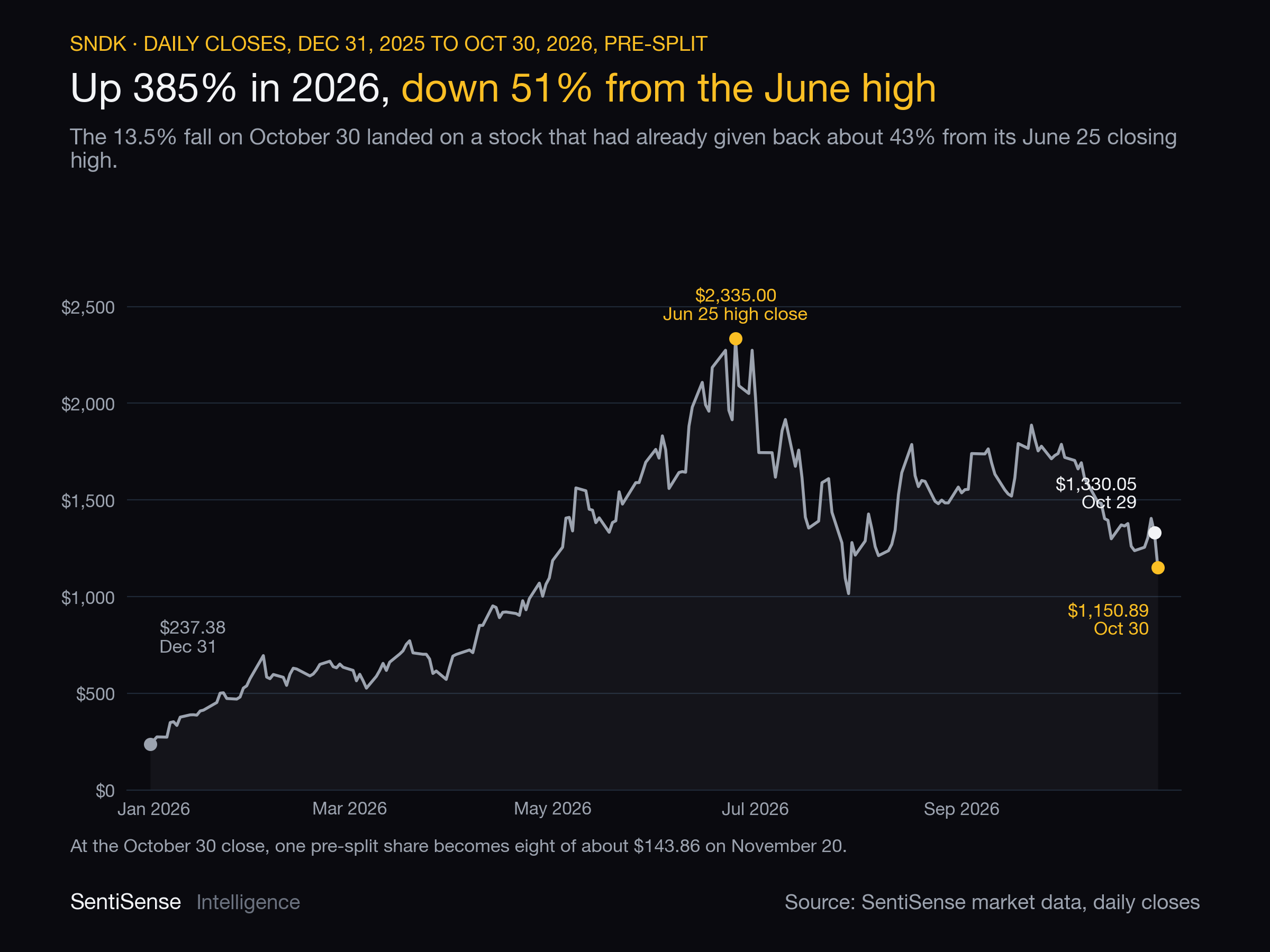
SNDK daily closes, December 31, 2025 to October 30, 2026, pre-split. Marked: the 2025 close, the June 25 closing high, and the closes on either side of the October 29 report. Source: SentiSense market data, daily closes. Chart: SentiSense.
Both sides of the price-cycle argument, in Sandisk's own words. The case that this is a cycle is in the 10-K's risk factors. Competitive conditions "including declining average selling prices, volatile demand, technological change, industry consolidation, lengthy product qualifications, and supply constraints" can hurt the business; its products are "largely interchangeable with competitors' products", so a wrong demand forecast can produce "periods of product oversupply or undersupply"; and the business "remains subject to changes in seasonal and cyclical supply and demand patterns". A company that sells an interchangeable product at a price that more than quadrupled in a year is describing a commodity cycle, whatever is driving the demand.
The case that this one is different is in the 10-Q. Sandisk expects "these favorable pricing trends and product mix shifts to have a positive impact on our revenue and cash flows from operations" and expects "AI-driven demand to persist through calendar year 2027 and beyond". Since the second half of fiscal 2026 it has signed long-term agreements it calls New Business Models with several Datacenter and Edge customers: multi-year commitments to deliver and to buy stated volumes, with fixed and variable pricing components, supported by financial guarantees. Contract liabilities, mostly customer payments in advance under those agreements, were $1.5 billion at October 2; refund liabilities, mostly security deposits collected under them, were $1.6 billion. Customers putting up deposits to secure flash supply is the strongest single piece of evidence in the filing that the tightness is real and that some of the price is now under contract. Sandisk's own framing is the fair one: the agreements "do not eliminate the risks associated with customer demand, market conditions, or operational execution", but the company believes "they reduce certain elements of industry cyclicality".
What would settle it. Four checkpoints, in the order they arrive.
1. November 20, the first split-adjusted session. Read every price that day with the division in mind: a print near $144 is the October 30 close in new units, not a collapse. 2. The next quarterly report, for the quarter to early January 2027. Revenue against $12.2 billion to $12.6 billion and non-GAAP gross margin against 84.5% to 85.5%. Above the range on both would say the price cycle has more to run; revenue inside the range with margin below it would say price has turned while volume holds. 3. The 10-Q behind that report, which will state exabytes sold and revenue per gigabyte by end market again. Datacenter volume rising on a flat price would be a different company from price rising on falling volume. This is the line we would read first. 4. Contract and refund liabilities under the long-term agreements. Rising deposits mean customers are still paying to lock in supply; falling ones mean the queue is shortening.
Our conclusion. The split is a unit change, and Sandisk says so. The 378% is a price story on roughly flat volume; the growth rate has stepped down twice and the guide steps it down again with a flat margin. That makes the question for a holder "how long does a NAND price cycle last, and how much of it is under contract", not "what does the split do". The filings give both answers room, and the next 10-Q's exabyte and revenue-per-gigabyte lines will settle more than the share count ever could. We are not forecasting the stock.
Dated November 2, 2026. Company disclosures through the 10-Q filed October 30, 2026; daily closes through October 30, 2026, pre-split. Informational and educational only, not investment advice.
Timeline
INITIAL · Nov 2, 4:34 PM ET
November 2, 2026 analysis. Split terms from the October 29 8-K; results, guide and the split rationale from the October 29 release; the exabyte and revenue-per-gigabyte lines, the pro forma per-share figures and the long-term agreements from the 10-Q filed October 30; risk-factor language from the 10-K filed August 17; earlier quarters from the 10-Qs of January 30 and May 1, 2026. Daily closes through October 30, pre-split. The piece makes no stock-price forecast; the next checkpoints are November 20 and the report for the quarter to early January 2027.
Related Stocks
Powered by SentiSense - Intelligent Market Analysis