SpaceX's shareholders still think it's a rocket company. The third quarter was sold by the gigawatt
SentiSense Original · Published · Updated · AI-assisted, editor-reviewed
SpaceX's first full quarter as a public company put its Super Intelligence segment at $7.56 billion of $14.58 billion in revenue, 52% of the total and up from $813 million a year ago, with $40.0 billion of the year's $48.1 billion of capital spending going to compute. On the shareholder question board, two thirds of the upvotes went to Starship, Artemis and the Louisiana spaceport; the AI segment drew 12%. On the call, CFO Bret Johnsen raised the compute target to 2.5 to 3 gigawatts by year end, guided first-quarter 2027 revenue to $33 billion to $37 billion, and set fourth-quarter capital spending at $35 billion to $40 billion. Elon Musk said the plan implies $500 billion to $1 trillion of annual recurring revenue by the end of 2027, and called a Tesla merger a good idea that now sits with two special committees he cannot join. By 7:22 pm ET, SPCX traded about 7% above its close after hours.
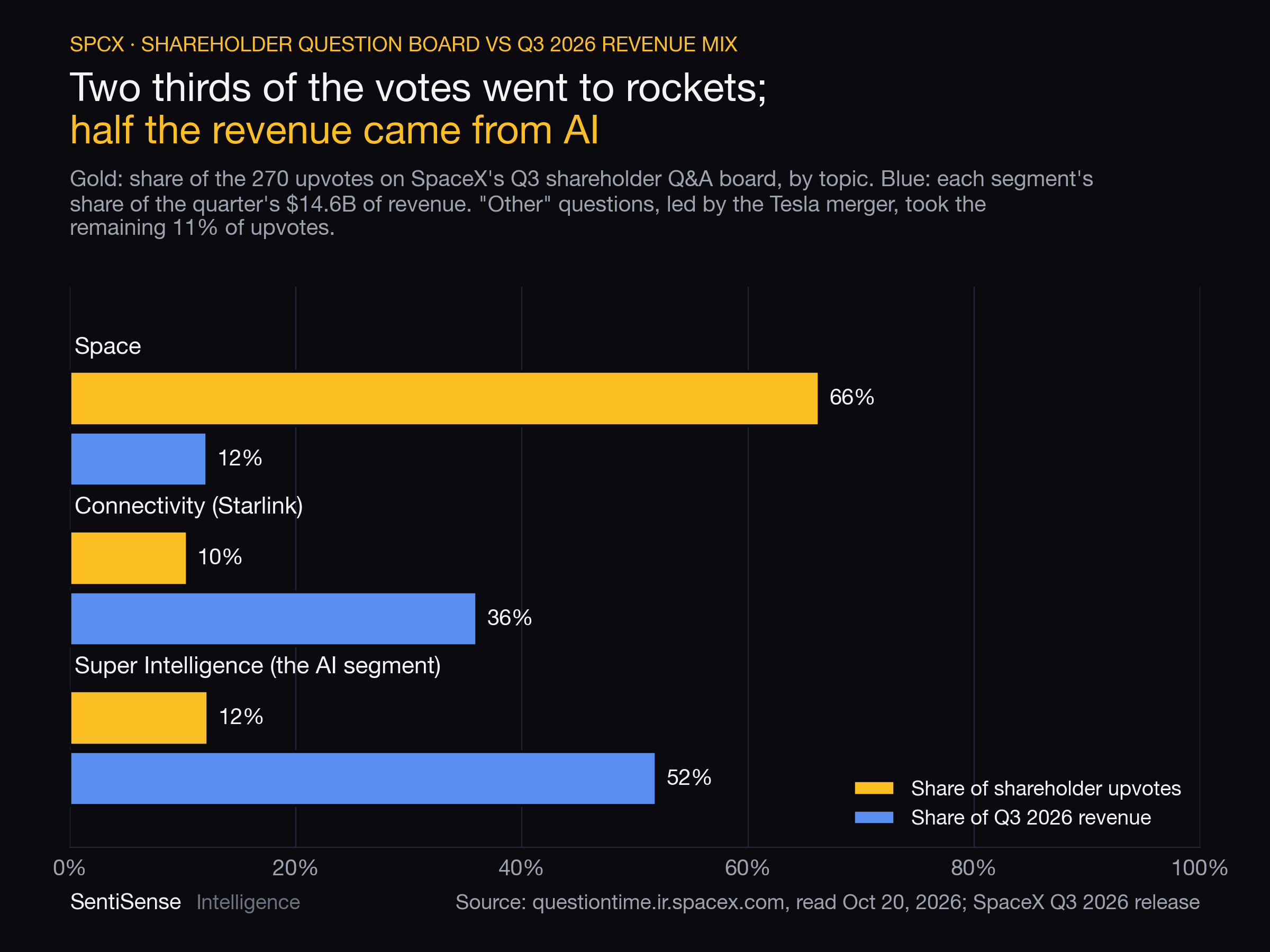
SpaceX asked its shareholders what they wanted to hear about, and they said rockets. Of the 270 upvotes on the company's third-quarter question board, which closed Monday afternoon, 179 went to Space topics: lunar lander hardware at Starbase, orbital refueling, the Louisiana spaceport, a bigger Starship payload door. The AI segment drew 33 upvotes, 12%. Then the quarter arrived on Tuesday after the close, and the segment the shareholders barely asked about was 52% of revenue: $7.56 billion of $14.58 billion, up from $813 million a year earlier. Space, the segment that won the vote, was $1.77 billion, 12%, and lost $7 million at the operating line. This piece is about the gap between what SPCX holders think they own and what the numbers say they own, and about the places where the call and the release stopped agreeing with each other.
The numbers, before the story. Revenue was $14.58 billion, up 161% from $5.58 billion, against the $12.86 billion analysts expected on the Visible Alpha consensus Fortune cited at 4:32 pm. Most of the gap was the Super Intelligence segment, SpaceX's name for its AI business: $7.56 billion against the $6.47 billion Fortune reported analysts had expected, with Connectivity and Space each about $0.3 billion ahead of the figures it cited. Connectivity, which is Starlink, was $5.25 billion, up 69%; Space was $1.77 billion, up 6%. Income from operations was $2.79 billion against a $273 million loss a year ago, and adjusted EBITDA, the company's own measure, was $8.81 billion. Net income of $4.40 billion needs its context: $2.79 billion of it is the operating result, and the rest is $873 million of interest income on the cash the IPO raised, $1.03 billion of other income, $561 million of that from a related party, and a $390 million tax benefit, less $675 million of interest expense. Diluted earnings per share were $0.35, against the $0.14 estimate in our calendar; estimates for this quarter mixed adjusted and GAAP bases, so we print no comparison word.
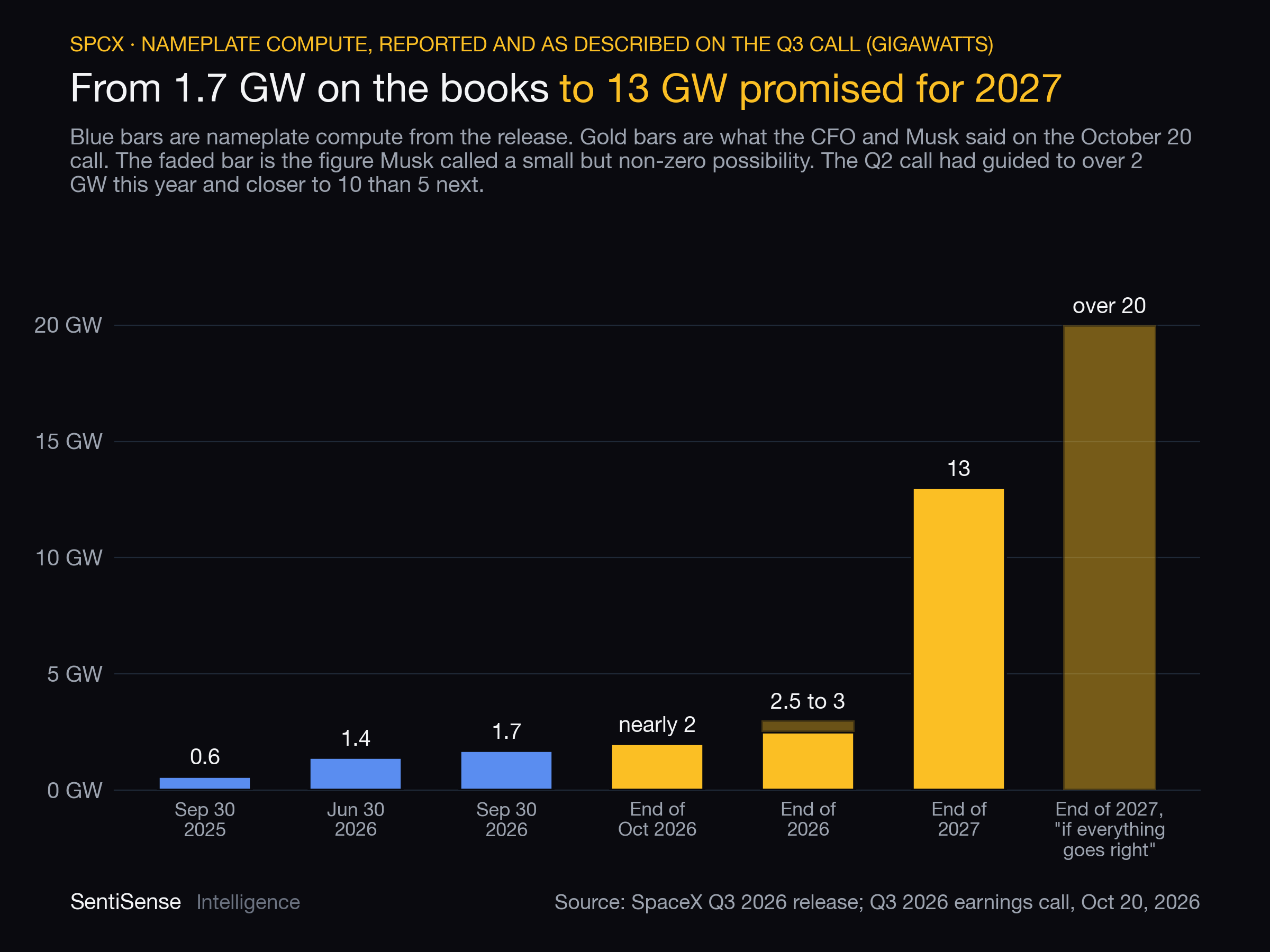
What the compute segment actually sells. Of the $7.56 billion, $7.02 billion was what SpaceX calls SI solutions and infrastructure, and the release says the growth was "primarily driven by the activation of new cloud services agreements, the acquisition of Cursor, and increased Grok adoption". Cursor, closed August 14 at an implied $60 billion equity value, contributed $608 million of revenue in its seven weeks; the rest of the jump is mainly SpaceX renting its data centers to other companies. On the call, CFO Bret Johnsen said that excluding Cursor, SI solutions and infrastructure revenue grew 192% from the second quarter, "driven primarily by the activation of new cloud services agreements," that pricing is "tracking slightly above the high end of the $30-$50 per watt range," and that "at current pricing, new compute deployments are generating a payback of less than a year". The segment ended the quarter with 1.7 gigawatts of nameplate compute, up from 1.4 at June 30 and 0.6 a year earlier, and it absorbed $16.4 billion of the quarter's $19.6 billion of capital spending. Over nine months, $40.0 billion of the $48.1 billion SpaceX spent on property and equipment went to the SI segment; Space got $3.8 billion and Connectivity $4.2 billion. That is a landlord's capital budget, with the rockets as a tenant.
The biggest tenant may be SpaceX itself. Asked by Goldman Sachs's Eric Sheridan how the compute splits between outside customers and the company's own Grok models, Musk said "our goal is to split it 50/50, more or less, where half of the compute is used internally and half of it is rented to others," and that the company rents "at effectively the spot market rate as opposed to sign these long-term deals," on the view that compute will be worth more per watt over time, not less. "We could rent out our compute several times over if we said yes to everyone," he said. On Grok Bot, the agent product launched in August, Gwynne Shotwell, SpaceX's president, said it had 800,000 paid weekly users earlier this month, "more than doubling over the last month". Musk went further: "I think Grok Bot may end up being what uses most of our SI compute". One of the ten most-upvoted shareholder questions had asked exactly that, what share of the data centers Grok and Grok Bot would use in 2027. If Musk is right, the landlord's best customer is a product it owns, and the segment's revenue depends on how the company prices compute to itself as much as on what outsiders pay.
The compute targets went up, and the second-quarter call is the measure. In August, Musk told that call "we expect to end this year with over 2 gigawatts of compute," and that by the end of 2027 the figure "may, let's say, be closer to 10 gigawatts of compute than 5 gigawatts of compute"; Johnsen repeated the year-end marker in his own remarks. On Tuesday, Johnsen said the company expects "nearly 2 gigawatts of nameplate compute at the end of this month alone" and "2.5-3 gigawatts just by the end of this quarter". Musk said the team is turning on "220,000 GB300s a month," that "I would be surprised if we brought on less than 13 gigawatts of compute by the end of next year," that the plan calls for 20 gigawatts of incremental power and cooling in 2027, and that there is "a non-zero possibility, maybe it's a small possibility at this point, but it's not zero, of SpaceX having over 20 gigawatts of SI compute online next year". The bottleneck, in his telling, has moved from chips to power, cooling and the turbine castings suppliers cannot deliver on time, which SpaceX now casts itself; "this is a bit like the New York Yankees playing in Little League," he said of putting the launch team onto terrestrial infrastructure.
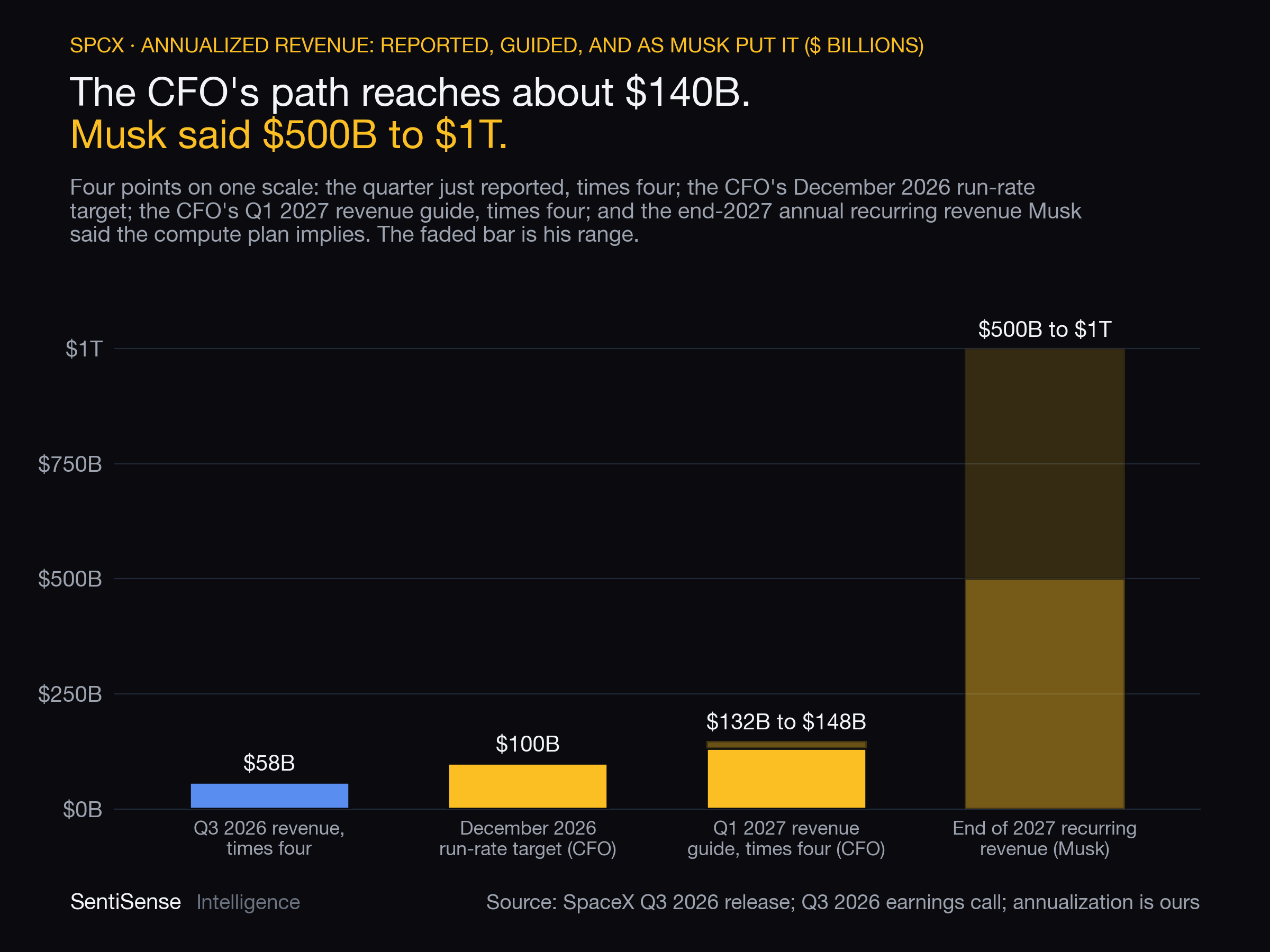
Where the call and the numbers stop agreeing. Johnsen gave the company's first explicit revenue guide: "We now see total company revenues in the range of $33 billion-$37 billion for Q1 of 2027," and repeated that SpaceX is "on track to deliver our previously stated goal of $100 billion in ARR by the end of this year, defined as annualized revenue based on the month of December". Multiply the quarter just reported by four and you get $58 billion; the December target is $100 billion; the first-quarter guide, times four, is $132 billion to $148 billion. Minutes earlier, Musk had closed his prepared remarks with a different number: "what this implies for SpaceX annual recurring revenue by the end of 2027 is somewhere between $500 billion and $1 trillion". Shotwell took the handoff with "on that crazy note," and Musk added, "I don't want to give Bret a heart attack". Both figures were said on the same call by the two people responsible for them. On the CFO's path the company is running at about $140 billion a year by March; Musk's lower bound needs it to more than triple again in the following nine months, and his upper bound needs it to grow seven-fold. Nothing in the release reaches that far: backlog was $63 billion at September 30, with about $42 billion of it expected to be recognized within a year.
Three smaller places the release and the cheer diverge. Starlink added 1.6 million consumer subscribers, to 13.6 million; Fortune reported analysts had expected 2.29 million. Johnsen's explanation was channel timing: the company "prioritized delivery of kits to retail channels ahead of the holiday season, which we expect will lead to increased activations in Q4". Monthly consumer revenue per user rose 5% to $69 on what the CFO called "a favorable customer mix dynamic," and Connectivity's 55% gross margin included about three points of one-time tariff refunds, so Johnsen expects fourth-quarter gross margins "to be more consistent with the second quarter". And on Louisiana, the release targets a first launch in 2029, while Musk said "our internal aspiration for first launch from Louisiana is actually in 2 years. So 2028 is our goal. But I think 2029 is highly likely". None of these is a crack in the quarter. They are the places where the document was written more carefully than the call.
Paying for 13 gigawatts. Capital spending was $19.6 billion in the quarter and $48.1 billion over nine months; Johnsen now expects $35 billion to $40 billion in the fourth quarter alone, which puts the year at roughly $83 billion to $88 billion, our arithmetic. Against that, operating cash flow was $13.1 billion for the nine months. The balance sheet can carry the gap for a while: $51.3 billion of cash and $38.6 billion of marketable securities at September 30, after $85.7 billion of net IPO proceeds, against $38.8 billion of debt and finance leases, $12.9 billion of it owed to related parties. Asked by J.P. Morgan's Doug Anmuth how the build gets funded, Johnsen pointed to the investment-grade rating and said "there are a number of available pools of debt capital that we are talking to at the moment related to funding this incredible growth," adding that the short payback means "this capability starts to fund itself in a pretty near-term situation". Musk's version: "you'd be hard-pressed to find any company in the world that is as good at capital efficiency as SpaceX". The arithmetic the market will test is simple. If a gigawatt pays back in under a year at today's pricing, the plan funds itself after the first wave; if the price per watt falls as 13 gigawatts of SpaceX capacity and everyone else's come online, the debt pools get used.
The rocket company is still in there, and it is next month's story. Space revenue of $1.77 billion was up 84% from the second quarter on customer mix, and the segment flew 35 launches in the quarter, including Starship Flight 14, which the release calls the first revenue-generating Starship mission: 26 Starlink V3 satellites, about ten Falcon 9 launches' worth of downlink capacity in one flight. Flight 15, which Musk expects "next month," will try to catch both the booster and the ship: "If we succeed, it will be the first time that an orbital launch vehicle has been fully recovered". He put the odds plainly: "Success is not guaranteed on these first flights, but I'd say it's more likely than not that this succeeds next flight". Shotwell said the company expects the FAA license for Flight 15 to include return to launch site and tower catch for both stages. Starlink, meanwhile, is the segment that pays the bills today: $2.37 billion of operating income, up 99%, 13.6 million consumer subscribers, 3,800 aircraft equipped against roughly 12,000 contracted, and 22 million monthly users on Starlink Mobile. Musk said he sees "a clear path to several hundred billion dollars a year in connectivity revenue" and promised a longer presentation on it.
The merger question, answered as far as it can be. The second most-upvoted shareholder question, with 26 votes, was when SpaceX will merge with Tesla. Deutsche Bank's Edison Yu asked it on the call. "This is definitely a kind of question where I feel like I am tap dancing through a minefield," Musk said. He said both companies "have formed special committees to discuss this idea, at the request of shareholders," made up of independent directors, and that "because I am a conflicted party, I cannot actually be in the discussions". "I think some people out there assume that a SpaceX and Tesla merger is a certainty, and I think that would be overstating it. Do I think it would be a good idea? Yes," he said, and later: "the special committees have not reached agreement on the terms of any transaction". On the vote, Musk said that "particularly on the Tesla side, we will need a 50% vote of all shares, not just those who vote, but of all shareholders". The charters bear that out in shape: both companies set the merger vote at a majority of outstanding shares. At SpaceX that vote is effectively Musk's, since he controls about 84% of the voting power. At TSLA, where the proxy filed Monday puts his stake at 19.8%, other shareholders decide. Tesla reports its own third quarter on Wednesday after the close, the first chance to hear the other committee's side.
How the conversation and the tape read it. SpaceX drew 424 mentions in the news and social coverage we track on Monday, the busiest day since October 9 and about 1.8 times the median of the 30 days before, and SentiSense's Score for the company, our daily read of how bullish or bearish that coverage runs, turned strongly bullish on Monday, its warmest read since October 2. The options market was calmer: at Monday's close, at-the-money implied volatility was 57%, near the bottom of the stock's range as a listed company, and the largest open interest for the November 20 expiry sat at the $180 and $220 calls and the $130, $110 and $100 puts. The stock had come into the print down 14% from its October 6 close of $171.92; it closed Tuesday at $147.79, down 0.1%, and by 7:22 pm ET it was trading near $158 after hours, about 7% above the close, having ranged from $145.19 to $160.49 after the bell.
The dates, in order.
August 4: second-quarter results; on the call Musk sets the markers of "over 2 gigawatts" of compute by year end and "closer to 10 gigawatts than 5" by the end of 2027. August 14: the Cursor acquisition closes at an implied $60 billion equity value. September 30: the quarter ends with 1.7 GW of nameplate compute and 13.6 million Starlink consumer subscribers; in its final week, Starship Flight 14 reaches orbit and deploys 26 V3 satellites. October 6: SPCX closes at $171.92, its high for the month. October 8: SpaceX agrees to buy a nationwide 800 MHz low-band spectrum portfolio, with closing expected in the first half of 2027. October 19: the shareholder question board closes with Space topics holding 66% of upvotes and the Tesla merger as the second most-upvoted question; Tesla files its proxy showing Musk at 19.8%. October 20, 4:00 pm ET: the release; revenue $14.58 billion, SI $7.56 billion. 4:30 pm: the call; Q1 2027 revenue guided to $33 billion to $37 billion, Q4 capital spending to $35 billion to $40 billion, and Musk's $500 billion to $1 trillion. 7:22 pm: SPCX near $158 after hours, about 7% above the close. October 21, after the close: Tesla's third-quarter report. November: Starship Flight 15, the first attempt to catch both stages. End of December: the $100 billion run-rate test and the 2.5 to 3 GW nameplate print.
What to watch. Four things, each checkable. First, Flight 15: a caught booster and ship would be the milestone the shareholder board voted for, and Musk has already said the first attempt may fail. Second, Tesla's call on Wednesday: whether its special committee is described the same way, and whether anyone names a timetable. Third, the compute prints: nearly 2 GW at the end of October and 2.5 to 3 GW at year end are the first targets the company has put on a monthly clock, and the fourth-quarter capital spend of $35 billion to $40 billion will show whether the "pools of debt capital" get drawn. Fourth, first-quarter 2027 revenue against $33 billion to $37 billion, which is the CFO's number and the only one of the two ladders the company can be held to. None of these says where the stock goes next. They say whether SpaceX's shareholders are right to keep voting for rockets, or whether the company they own has already become something else.
SentiSense data as of October 20, 2026; prices through Tuesday's close and after-hours trades to 7:22 pm ET. Informational and educational only, not investment advice.
Timeline
INITIAL · Oct 20, 8:09 PM ET
Published Tuesday, October 20, 2026, after SpaceX's third-quarter release at 4:00 pm ET and the earnings call at 4:30 pm ET. Segment, cash flow and balance sheet figures are from the 8-K exhibit 99.1; call quotes are from the webcast; the shareholder question board was read at about 5:10 pm ET; the second-quarter markers are from that call's transcript; the merger vote mechanics are from both companies' charters, Tesla's proxy filed October 19 and SpaceX's June prospectus; prices, mention counts, options positioning and the SentiSense Score are our own reads of the SpaceX entity through 7:22 pm ET.
Related Stocks
Powered by SentiSense - Intelligent Market Analysis